Why Source Verification Needs Its Own Content Workflow
A source verification workflow is a separate content step where you confirm every fact, stat, quote, and citation before publishing, not during copyediting. Treat it as its own stage, give it its own checklist, and assign it to one accountable person. Skip this and you inherit every error your sources (and your AI tools) made before you.
I write SEO content for a living. I’ve also had to retract a stat I pulled from a “reputable” source that turned out to be three years outdated and misquoted. That one mistake cost me a client’s trust and a full afternoon of damage control. It taught me something most content teams learn the hard way: a source verification workflow only works when it’s a distinct step.
Most teams treat verification as part of proofreading. Someone checks grammar, checks the stats “look right,” and hits publish. That’s not verification. That’s a glance.
What Is A Source Verification Workflow?
A source verification workflow is a defined sequence of checks that confirms every factual claim in a piece before it goes live. It covers:
- Where each stat or quote originated
- Whether the original source still says what you think it says
- Whether a newer, more accurate source exists
- Whether the claim has been misquoted, exaggerated, or stripped of context along the way
It’s a workflow because it has steps, an owner, and a record. A one-off “let me Google that real quick” isn’t a workflow. It’s a guess with extra confidence.
If you can’t point to who checked a fact and when, you don’t have a verification workflow. You have hope.
Why Do Most Content Teams Skip This Step?
Three reasons, and none of them are good ones.
- Deadlines eat the slow steps first. Verification takes time. Under pressure, it’s the first task that gets compressed into “we’ll trust the source.”
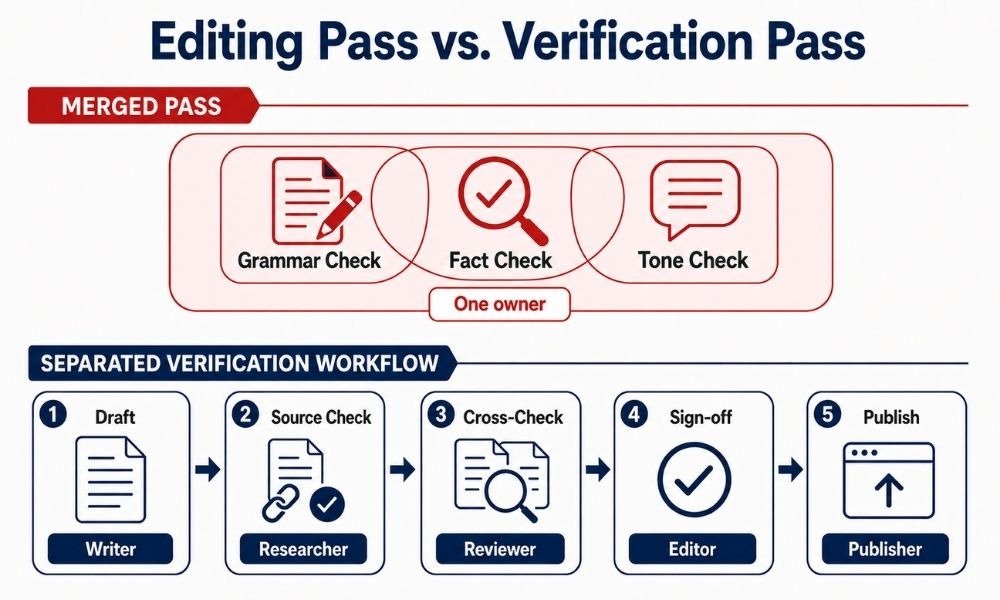
- Editing and verification get merged. One person is asked to fix sentence flow and confirm facts in the same pass. Those are different skills done at different speeds. Merging them means one gets rushed.
- AI-assisted drafts create false confidence. A draft that reads clean and well-structured feels finished. It isn’t. Fluency is not accuracy.
That third point matters more than most teams admit. Research on AI-generated citations found a 12.4% hallucination rate on citation accuracy tasks, even with extended reasoning enabled. Models invent author names, journal titles, and DOIs that look completely plausible. Nothing about the output signals “this is fabricated.” That’s exactly why it slips through when verification isn’t a dedicated step.
What Happens When You Skip It?
The cost isn’t abstract. It shows up in three places.
Your credibility
One wrong stat in a published piece is enough for a reader to question everything else on the page. Google’s own guidance on helpful content puts trustworthiness at the center of how it evaluates a page, and calls it the most important of the four E-E-A-T factors. A page can show experience and expertise and still fail if it isn’t accurate.
Your time
Research tracking enterprise AI use found employees spend around 4.3 hours a week checking AI-generated content after the fact, adding roughly $14,200 per employee per year in overhead. That’s the cost of catching errors after publishing instead of before. Verification upfront is cheaper than correction later.
Your rankings
Content that gets corrected, retracted, or flagged for accuracy issues loses trust signals over time. Search engines and AI answer engines both weigh whether a source has a track record of being right.
Every hour you save by skipping verification, you pay back with interest during correction, retraction, or reputation repair.
How Do You Build A Verification Workflow Into Your Process?
Give verification its own lane. Here’s a structure that works for a solo writer or a small team.
| Stage | What Happens | Who Owns It |
| Draft | Writer flags every claim, stat, and quote inline | Writer |
| Source check | Confirm each flagged claim against its original source | Verifier (can be the writer, at a separate pass) |
| Cross-check | Search for a newer or more authoritative source | Verifier |
| Sign-off | Verifier confirms all claims are sourced and dated | Editor or verifier |
| Publish | Final scan for broken links and outdated stats | Editor |
Notice verification sits before sign-off, not folded into the final proofread. That separation is the whole point.
A few rules that keep this from becoming theater:
- Flag claims as you write, not after. Bracket every number, quote, or “studies show” the moment you draft it. Don’t rely on memory to find them later.
- Go to the primary source, not the article citing it. Secondary sources repeat and compound errors.
- Date every source you cite. A stat from 2021 doesn’t belong in a 2026 piece unless you say so.
- Keep a verification log. A simple spreadsheet with claim, source, date checked, and checker name. It takes five minutes and saves hours during a dispute.
Which Sources Deserve A Spot In Your Workflow?
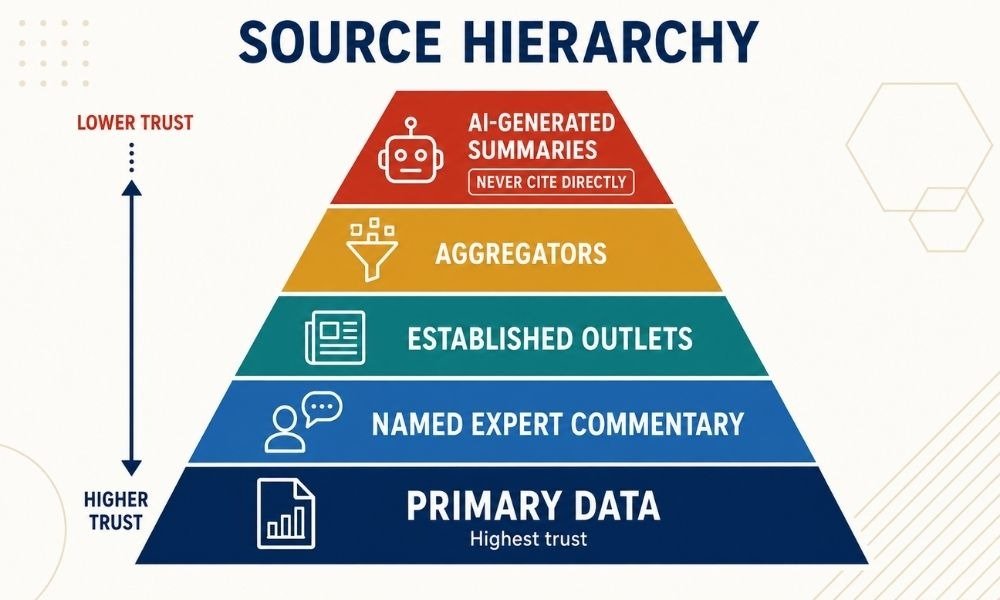
Not all sources carry equal weight. Rank them before you cite them.
- Primary data: government reports, original research papers, company filings. Highest trust.
- Named expert commentary: quotes attributed to a real person with a checkable role.
- Established outlets with editorial standards: outlets that publish corrections and cite their own sources.
- Aggregators and roundups: useful for finding leads, not for citing directly. Trace the claim back to its origin.
- AI-generated summaries: never cite directly. Treat as a starting point, not a source.
Journalism has run on a version of this test for decades: who says this, how do they know, are they biased, and what don’t you know yet. That four-question filter still works for content writers, not just reporters.
What Should You Check Before You Hit Publish?
A final pass, separate from your editing pass, covering:
- Every number matches its original source
- Every quote is attributed correctly and in context
- Every date is current, not outdated by a year or more
- Every link resolves to the actual source, not a dead page or a paywall
- Every claim from an AI tool has been checked against a real source
- A named person signed off on the check
Build this into your publishing checklist as a required field, not an optional one. If there’s no box to check, it won’t get checked.
FAQ
Does a source verification workflow slow down publishing?
It adds time upfront but removes the far longer cycle of corrections, retractions, and rebuilding reader trust after an error goes live. Most teams find it pays for itself within the first caught mistake.
Who should own source verification on a small content team?
Give it to one named person per piece, even if that person also writes or edits. The role matters more than the title. What matters is that someone signs off specifically on accuracy, separate from grammar and style.
How do I verify sources when I’m using AI tools to draft content?
Treat every AI-generated stat, quote, or citation as unverified until you trace it to a real, checkable source. AI models can produce confident, well-formatted citations that don’t exist. Never publish an AI-sourced claim without confirming it independently.
Your Next Step
A verification workflow only works if the rest of your content process supports it. If you’re publishing AI-assisted drafts, read how to make AI content sound human without losing SEO next. If you want your structure to match what readers are actually searching for before you even start verifying facts, check search intent for content writers.