
How to Make AI Content Sound Human Without Losing SEO
To make AI content sound human, edit for three things: sentence rhythm, specific evidence, and a real opinion. Cut the words no one says out loud (checklist below). Add one detail an AI model can’t know, like a number from your own work or a decision you made and why. Keep your structure and keywords intact. Google doesn’t rank content lower for using AI. It ranks flat, generic content lower, AI-made or not.
You already know how to make AI content sound human, or you think you do. Add a few contractions, cut some adjectives, swap “delve” for “look at.” Then you republish and the piece still reads flat. The gap isn’t vocabulary. It’s the decision layer AI can’t make for you: what to keep, what to cut, and what to add that only you know.
Should You Let AI Draft Your Content First?
Yes, if you treat the draft as raw material, not a finished piece. AI is fast at structure and slow at judgment. It can build you an outline, a first pass at headers, and a rough draft in minutes. What it can’t do is tell you which point matters most, because it doesn’t know your business, your customer objections, or what you tested last quarter.
Google’s own guidance backs this up. Google’s ranking systems reward original, high-quality content that shows expertise, experience, authoritativeness, and trustworthiness, and the company has said its focus stays on content quality rather than how that content gets produced. An AI draft isn’t a liability by default. An unedited one is.
Why AI Drafts Sound the Same
Every AI model pulls from similar training patterns, so drafts converge on the same phrasing. A Florida State University study found this pattern bleeding into real conversation too. Researchers tracked a measurable shift toward the formal language patterns common in AI chatbots, with words like meticulous, delve, and underscore showing up more often in everyday speech. If a model’s word choices are shaping how people talk, they’re shaping how your competitors’ blogs read too.
A separate review of published writing found the same drift.Terms including delve, underscore, primarily, meticulous, and boast saw the sharpest increases in use.None of these words are wrong on their own. They’re just everywhere now, which makes your content sound like everyone else’s.
Common tells worth checking for:
| AI Tell | Why It Reads Flat | Human Fix |
| “In today’s fast-paced digital age” | Says nothing specific | Cut it. Start with the point. |
| Three-item lists in every paragraph | Predictable rhythm | Vary sentence and list length |
| “It’s important to note” | Filler before the actual point | State the point directly |
| “On one hand, on the other hand” | No real position taken | Pick a side and say why |
| Perfectly even paragraph lengths | No natural pacing | Mix one-line paragraphs with longer ones |
Why This Actually Affects Your Rankings
Robotic content doesn’t get flagged just for sounding generic. It gets outranked because it fails the same quality bar Google applies to everything else. Google’s Search Quality Rater Guidelines flag main content built with little effort, little originality, and little added value, no matter who or what wrote it. Flat AI content usually fails on originality first. It repeats what’s already ranking instead of adding a new angle.
This is also where trust breaks. A reader who spots several AI tells in your first three paragraphs assumes you didn’t check the facts either. That assumption costs you time on page, and time on page feeds the same engagement signals that support rankings.
The Edit Pass That Fixes an AI Draft
Run every AI draft through this pass before it goes near your CMS.
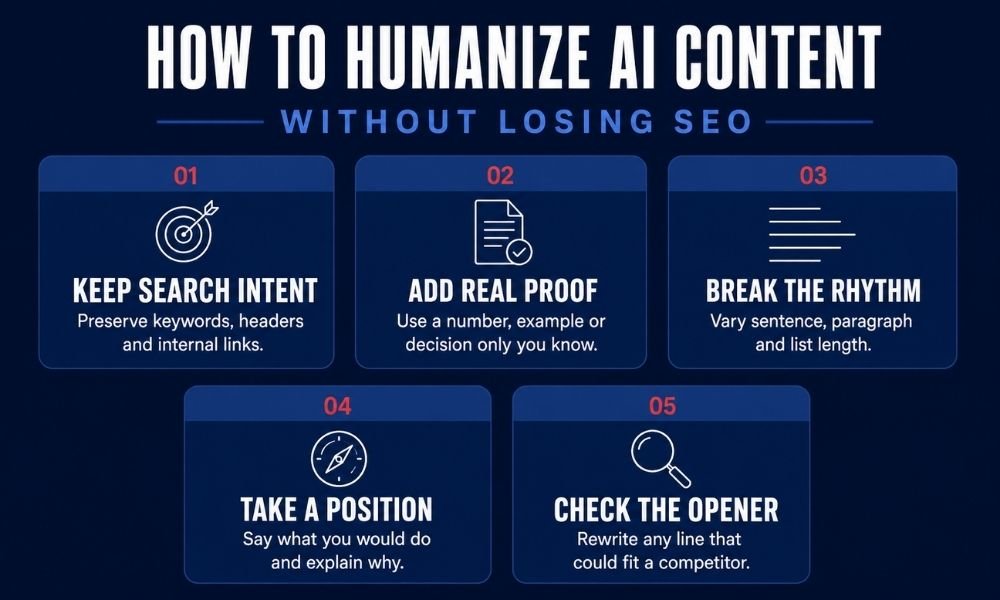
- Read it out loud. Any sentence you wouldn’t say to a colleague gets rewritten.
- Cut the hedge words. Remove “can,” “may,” and “often” where you actually know the answer.
- Add one number or example only you have. A client result, a test you ran, a mistake you made. This is the part AI can’t fake.
- Break the rhythm. Follow a long sentence with a short one. Follow a list with a plain paragraph.
- Take a position. Say what you’d do, not just what’s possible.
- Check the opening line. If it could sit on any competitor’s page, rewrite it around your specific angle.
This isn’t a style pass. It’s where your experience enters the piece, which is the exact signal Google’s quality raters are trained to look for.
What to Keep Intact While You Edit
Don’t let the humanizing pass wreck your SEO structure. Keep these fixed while you rewrite sentences:
- Your target keyword in the H1, the opening paragraph, and one or two H2s
- Your header hierarchy and order
- Internal links to related pages
- Schema and metadata
- Any stats or citations you’ve already sourced correctly
If your outline was built around search intent, keep it as is.
The Final Check Before You Publish
Before you hit publish, ask three questions:
- Does this page say something your last five competitors’ articles didn’t say?
- Could a reader tell this was written by someone who actually does this work?
- Would you send this to a client without editing it again?
If any answer is no, go back to the edit pass. Publishing on schedule matters less than publishing something worth citing.
FAQ
Does Google penalize AI-generated content?
No. Using automation to generate content only violates Google’s spam policies when the primary goal is manipulating rankings, and appropriate use of AI or automation on its own is not against Google’s guidelines. Thin, unedited content is the problem, not the tool.
How much editing does an AI draft actually need?
Enough that a reader can’t tell where the draft ended and your input started. That usually means rewriting the opening and closing of each section, adding at least one example the model couldn’t generate, and cutting anything that reads like filler.
Can AI detectors affect my search rankings?
No. Detector scores aren’t a Google ranking signal. What affects rankings is whether the page demonstrates real expertise and answers the query better than what’s already ranking, no matter what a detector guesses about how it was written.
Read Next
Fixing how your AI drafts sound is one part of a larger content system. Here’s where to go next:
- Why Original Thinking Matters More When AI Summarizes Everything
- Your Editing Process Is Quietly Defining Your Content Strategy
- How to Create Content AI Search Can Cite and Readers Can Trust
Want a second opinion on your content workflow? Get in touch and I’ll review what’s slowing your team down.