How to Create Content AI Search Can Cite and Readers Can Trust
AI search content must give readers something the generated answer cannot carry on its own. If the source gives a basic explanation, a familiar checklist, or a summary of existing advice, people have little reason to visit the source. Your content gets noticed when it has a contribution that readers can trace back to your experience, evidence and judgement.
This is important because AI-generated answers take up more space in search. The Wall Street Journal reports that major publishers are already seeing steep declines in organic Google traffic. The same shift applies to business owners and professionals even if traffic to the website is driving authority, not advertising dollars.
The question for each blog has changed. What does this article give the reader that an AI summary would struggle to reproduce accurately without citing the source?
Give Every Article an Identifiable Contribution
Many business blogs contain accurate information. Accuracy alone rarely makes an article memorable or source-worthy because dozens of pages may present the same points.
An identifiable contribution gives the article a clear reason to exist. It may come from:
- A pattern you have seen across client work
- Original data or documented results
- A framework you created to solve a recurring problem
- A conclusion drawn from several credible sources
- A clear position supported by professional experience
- An exception that changes the usual recommendation
The contribution should be specific enough for someone to associate it with your business. If another company could replace your name on the article without changing its meaning, the content probably relies too heavily on common knowledge.
Move From Information to Interpretation
AI tools can combine definitions, statistics, and established advice quickly. Your advantage comes from explaining what the information means in practice.
Suppose several studies show that AI search retrieves different sources from traditional Google results. Repeating that finding gives the reader an update. Explaining how it should change a company’s content brief gives the reader direction.
A 2026 study of 11,500 real queries found less than 0.2 average source overlap between traditional Google Search, Google AI Overviews, and Gemini. The researchers also found that AI results could change between repeated or slightly edited queries. This suggests that a strong organic ranking cannot be treated as automatic AI visibility.
For a content strategist, the useful work begins after that finding. What should a business change? Which assumptions should it question? What evidence should its writers collect? Those decisions turn research into expert-led content.
Make Your Claims Easy to Trace
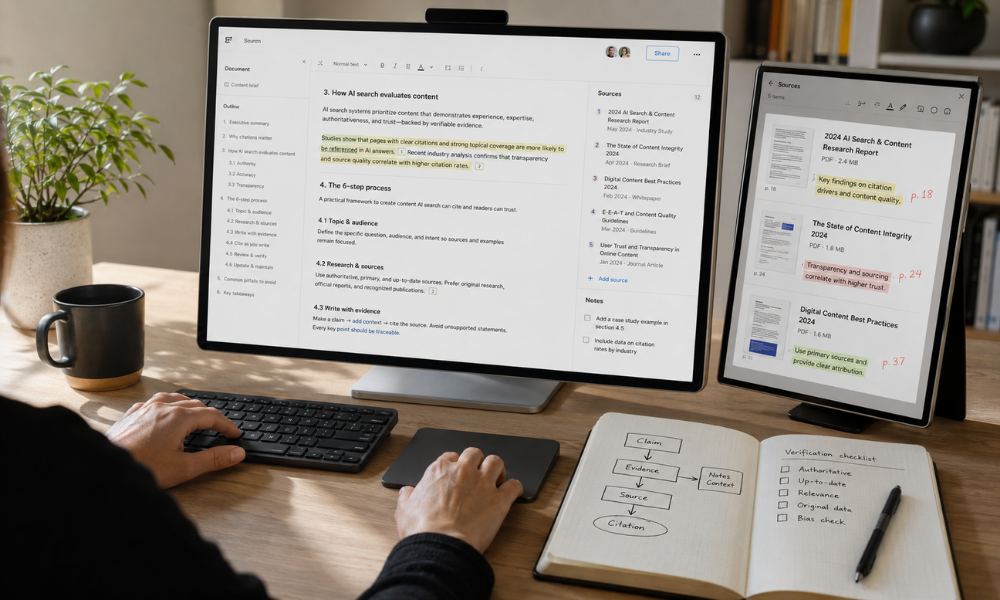
Trust weakens when a blog makes broad claims without showing where they came from. Readers need to see the line connecting evidence, interpretation, and conclusion.
For each important claim, ask:
- What supports this statement?
- Does the source prove the full claim or only part of it?
- Which conclusion comes from the source?
- Which conclusion comes from my own experience?
- Have I made that distinction clear?
This approach protects the integrity of your argument. It also gives AI systems clearer material to reference because the article connects a defined claim to named evidence and a specific interpretation.
Add the Context an AI Summary May Remove
Summaries compress information. During that process, they can lose conditions, limitations, uncertainty, and exceptions.
Your blog should preserve the details that affect a reader’s decision. Explain when your recommendation applies, when it may fail, and what would cause you to choose another approach. These details show judgment and prevent readers from applying general advice to the wrong situation.
For example, “publish original research” sounds useful, yet many small businesses lack the data volume needed for a credible study. A better recommendation may involve analyzing recurring customer questions, documenting internal decisions, or comparing observations from completed projects. The limitation makes the advice more usable.
Test the Article Before Publishing
Before publishing content for AI search, remove the title and company name, then read the draft again. Can you still identify the business behind the thinking? Can you point to one claim, framework, or conclusion that belongs specifically to that source?
If the answer is unclear, the article needs a stronger contribution. Add evidence, explain your reasoning, define the limits, or make a clearer judgment. Search visibility can bring the article into view, but its source value gives readers a reason to remember where the insight came from.
For related guidance, read The Content Proof Gap: Why Your Best SEO Content Starts Before Writing.