Your Website Can’t Carry Your Authority Alone
Your website matters, but it cannot do the whole authority job by itself. Not anymore. If your best thinking only lives on your own site, people may still miss the proof they need before they trust you.
That is especially true for business owners, consultants, executives, agencies, and professionals. Your audience may first see you on LinkedIn, hear your name through a referral, check your website later, then look for proof somewhere else. They are not moving in one straight line.
Search is also changing that behaviour. Google’s AI Search guidance still points website owners back to helpful, reliable content, but it also makes clear that visibility across AI features depends on useful, unique, well-structured content that adds value beyond common information.
Your Website Is The Base, Not The Full System
A website gives your authority a home. It gives people a place to understand what you do, read your thinking, see your services, and decide if your work feels relevant. That still matters.
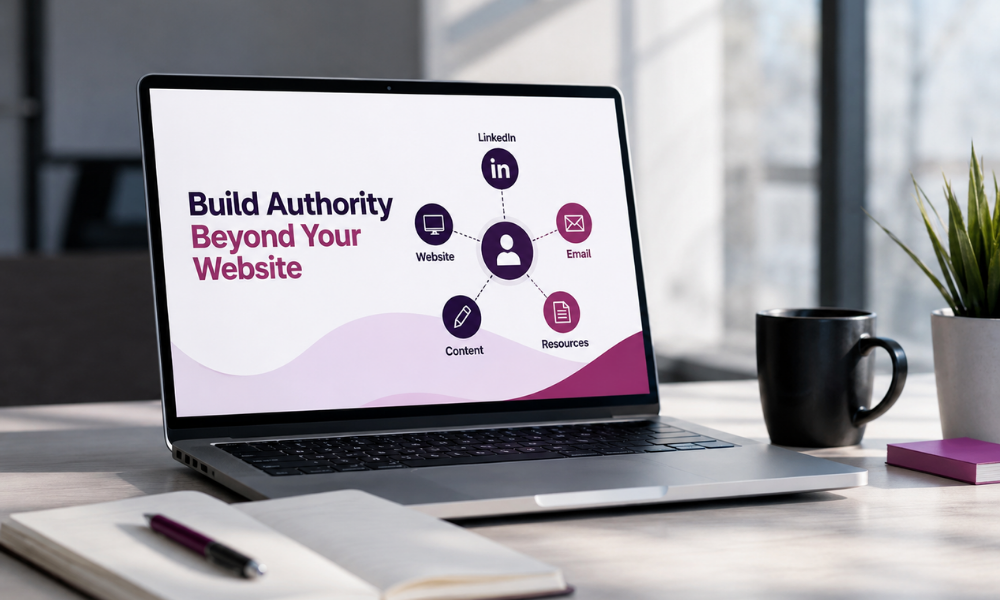
The mistake is expecting the website to carry every trust signal alone. A blog post can explain your point of view, but a LinkedIn post can show how you think in real time. A client resource can show how you guide people. A podcast, interview, or third-party mention can show that someone else sees value in your expertise.
That wider footprint helps people connect the dots. It also gives your ideas more chances to be found, quoted, shared, remembered, and searched again. One page on your website is useful. A connected body of proof is stronger.
Authority Needs Repetition Across The Right Places
People usually do not trust expertise after one post. They trust it after seeing a pattern. They notice what you keep explaining, what you believe, what you challenge, and how consistently your content reflects real work.
That does not mean repeating the same post everywhere. It means letting one strong idea travel in different formats. A blog can hold the full argument, a LinkedIn post can share the sharper observation, a newsletter can apply it to a current problem, and a short resource can give the reader a next step.
This is how a content strategy becomes an authority system. The goal is not to be everywhere. The goal is to make your expertise easier to recognise wherever someone comes across it.

AI Search Looks Beyond Your Blog
AI search has made this more important because source selection does not always follow the old ranking path. Ahrefs found that only 38% of pages cited in AI Overviews also ranked in Google’s top 10 for the same query. That means useful content can be surfaced from places outside the usual first-page winners.
That should not make anyone abandon SEO. It should change how business owners think about visibility. Your website still needs strong content, but your authority should also show up in the places where people and search systems gather context.
A 2026 Business Insider report also noted that AI engines can prioritise widely agreed-upon information across the internet, which makes earned media, reviews, external platforms, and structured information more important to brand visibility.
The point is simple. Your website is one signal. Your wider digital footprint can support or weaken that signal.
One Strong Idea Should Work Harder
A lot of businesses treat content as isolated pieces. A blog goes on the website. A LinkedIn post goes on LinkedIn. A newsletter goes to the list. Nothing connects.
That creates more work than needed, and it weakens the idea. If you already have a strong insight, build around it. Do not let it sit in one format and disappear after one publish date.
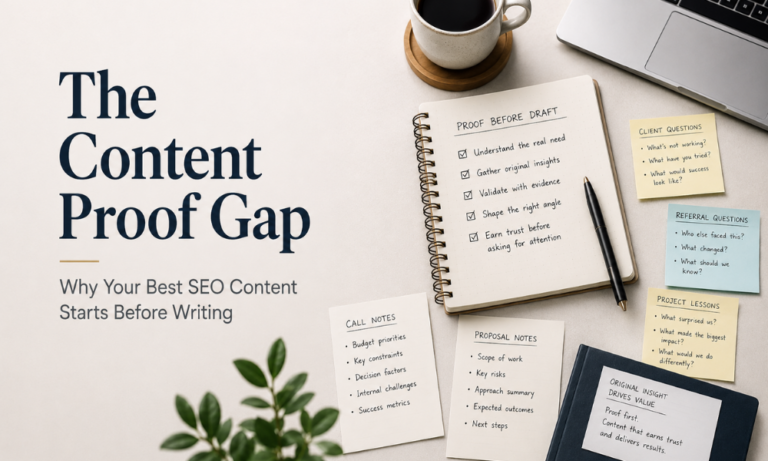
For example, a blog about proof-led content can become a LinkedIn post about thin briefs, a checklist lead magnet, a short email about client questions, and a service page section about your process. Same core insight. Different job for each format.
That is not lazy repurposing. That is strategy. You are making the same expertise easier to find, easier to understand, and easier to trust.
Build A Footprint Around Proof
This is where content strategy needs to get more practical. Before publishing, ask where the idea should live and what proof each format should carry. Not every idea needs a full campaign, but stronger ideas should have more than one place to work.
Your website should hold the deeper thinking. LinkedIn should show your point of view in a sharper, more current way. Your emails should help people apply the idea. Your resources should turn the thinking into something useful.
Reviews, referrals, interviews, collaborations, and client-facing resources also matter. They show that your expertise does not only exist because you said it does. Other signals support it.
The Authority Gap
The real issue is not that businesses need more platforms. The issue is that their best thinking often lives in one place, or worse, it stays inside private conversations. That creates an authority gap.
People may respect you after a call, but your content does not show the same depth. Your website may explain your services, but your LinkedIn does not show your thinking. Your blog may rank, but the rest of your presence does not support the same message.
That gap makes it harder for people to remember you, refer you, or trust your perspective before they speak with you. Strong authority feels connected. The message is not identical everywhere, but the thinking is consistent.
What To Do Next
Start with one idea you want to be known for. Then decide how it should show up across your website, LinkedIn, email list, and resources. Keep the idea clear, but adjust the format based on what the reader needs in that place.
That is how your content starts to build a wider authority system. Your website still matters. It just should not be working alone.
If your best thinking is scattered across calls, notes, posts, and unfinished drafts, I can help turn it into a clearer content system.
Contact me if you need help turning one strong idea into proof-led content that supports your authority across more than one platform.