
How to Decide Which Expert Insights Deserve Their Own Blog Post
An expert insight deserves its own blog post when it passes three checks: it holds up as one clear claim, you can back it with real evidence, and someone actually searches for the problem behind it. If the idea only works as part of a bigger argument, or repeats a post you already have live, keep it as a section, a LinkedIn post, or an FAQ entry instead
Deciding which expert insights deserve their own blog post is the real bottleneck for founders and consultants who know more than they publish. You collect opinions from client calls, observations from years in the field, and takes that never leave your notes app. The question isn’t whether the insight is good. It’s whether it can carry 1,000 words on its own, without you padding it out to hit a word count.
I run every client insight through a scorecard before it becomes a published post. Here’s how that works, step by step.
What Makes An Insight Strong Enough To Carry A Post
A blog-worthy insight has three things going for it.
- A single claim. You can say it in one sentence, and that sentence takes a position. “Content strategy matters” is not a claim. “Most content calendars fail because they schedule topics before they schedule proof” is a claim.
- A reason it’s true. You’ve seen it happen more than once, across more than one client or project.
- A reader who’s stuck on it right now. Someone is actively trying to solve the problem your insight answers, not just curious about the topic in general.
If your insight only has one of these, it’s not ready. It might still be true and useful, but it belongs in a shorter format until it earns the other two.
Why Most Expert Insights Fail As Standalone Posts
I turn down more insight ideas than I approve. Three failure patterns show up again and again.
The insight is actually an observation. “Clients often confuse SEO with content marketing” is an observation. It describes a pattern but doesn’t tell the reader what to do differently. A post built on it drifts into general commentary because there’s no decision at the center.
The evidence lives in your head, not on the page. You know the insight is true because you’ve lived it. But if the post can’t point to a project, a number, a before-and-after, or a documented example, readers have to take your word for it. That’s a weak foundation, especially since Google’s search quality guidance asks pages to show who created the content and why, not just state a claim with authority attached to it.
Nobody is searching for it. This is the one people skip. You can have a sharp, well-supported claim that still doesn’t match a real query. That doesn’t mean the insight is wrong. It means a blog post isn’t the right home for it. A newsletter or a talk might serve it better.
How Do You Test An Insight Before You Write It
I use a short scorecard instead of a gut check. Score each row 0 to 2, and add it up.
| Test | Question To Ask | Score 2 | Score 0 |
| Claim | Can you state it as one sentence with a position? | Yes, in under 20 words | You need a paragraph to explain it |
| Proof | Do you have a specific example, number, or case behind it? | Named project or measurable result | “I’ve just noticed this over the years” |
| Reader stake | Does it change a decision the reader is about to make? | Changes what they do next | Interesting, but no action follows |
| Search shape | Does it match a real question or problem people type into Google? | Clear query match | No related search volume or intent |
Six or above out of eight: write the standalone post. Four or five: the insight is close but needs one more source or a narrower claim before you commit a full article to it. Below four: reroute it, which brings up the next question.
Where Do Insights That Don’t Pass The Test Go
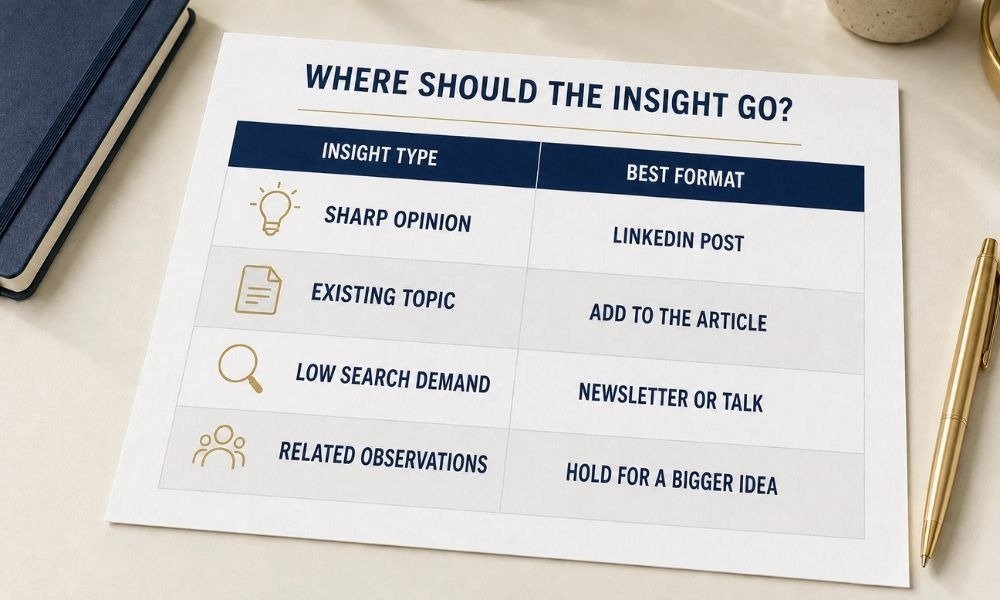
A low score doesn’t mean the insight is wasted. It means the format is wrong.
| If The Insight Is… | Send It To… |
| A sharp opinion with thin evidence | A LinkedIn post, where audience reaction can supply the missing proof |
| A narrow clarification of something you’ve already published | A section added to that existing post |
| True but not searched for | An email newsletter or a talk, where you don’t need search intent |
| One of several related observations | A holding doc, until enough of them combine into one bigger argument |
This is also where repetition gets caught early. Before I approve a topic, I check it against posts already live on the site. If two articles answer the same question with the same angle, one of them is unnecessary. My guide on how to avoid repetitive content across a business blog covers how to give each post its own reason to exist before you write it.
How Do You Structure The Post Once It Passes
Once an insight clears the scorecard, structure decides whether it actually reads as expert content or just looks like it.
- Open with the claim. State the position in the first two sentences. Readers and search engines both reward pages that answer the question immediately.
- Show the evidence early. Don’t save your best example for the end. Put it right after the claim so the reader trusts the rest of the post.
- Write toward one decision. Every section should push the reader closer to doing something differently, not just knowing more.
- Credit your sources. If you’re citing research, data, or another expert, link to the original. It backs up your claim and signals to readers that you checked your work instead of guessing.
Before you open a blank draft, write your insight as one sentence, list one piece of proof, and search the exact problem it solves. If all three exist, write the post. If one is missing, park the idea and go find what’s missing first.
FAQ
What should a good blog post include?
A good blog post needs one clear claim, evidence that backs it up, and a structure that lets the reader find the answer fast. Skip the claim or the proof, and the post reads like filler even if the writing is polished.
What makes a blog successful?
Consistency and originality do more than volume. A blog succeeds when each post answers a question no other post on the site already answers, not when it publishes on a fixed schedule regardless of whether there’s something new to say.
What kind of blogs are most successful?
Blogs built on first-hand experience and a specific point of view outperform blogs that summarize what’s already ranking. Google’s own quality guidance points to this directly: pages that show who created the content and why tend to hold up better than pages that just state information.
Read next: If you’re short on standalone ideas, my guide on finding content gaps inside your own expertise walks through where founders usually miss topics they already know cold. And if your blog has grown past a handful of posts, Topic Clusters for Digital Marketing shows how to organize insights so they build authority instead of competing with each other.