Search Intent for Content Writers: A Clear Guide
Search intent is the reason behind a search query, not just its topic. A keyword can carry more than one intent at once. To write for it, search the term yourself, study what format currently ranks (list, table, tool, guide), and match that format before you touch tone or keywords. Recheck every 60 to 90 days, because SERPs shift.
You match your keyword to the “correct” intent bucket. Informational, commercial, transactional, navigational. You write the guide, the listicle, or the product page to fit. Then rankings still slip in three months.
Search intent is not a label you assign once and forget. It is a moving target tied to a live SERP, and that SERP changes every time Google tests a new format. If you treat intent as a one-time classification step, your content decays quietly while you are not looking.
This guide covers what most intent guides skip: mixed-intent keywords, why matching the “right” bucket still fails, and how to check intent after you publish, not just before.
Why Do Writers Keep Misjudging Search Intent?
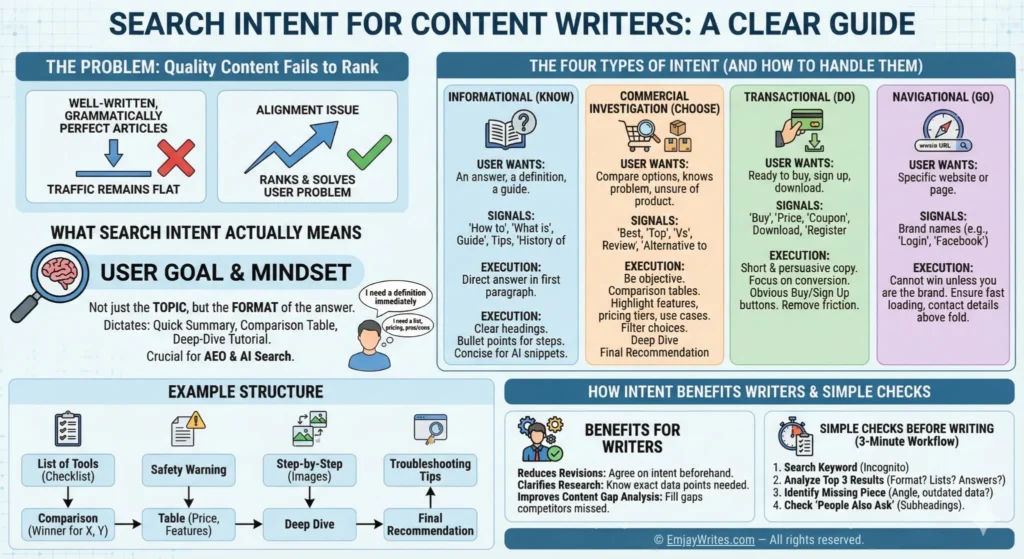
Most writers learn the four-bucket model early: Know, Do, Choose, Go. That model helps you avoid obvious mismatches, like writing a product page for a “how to” query. It does not help you with the harder problem: deciding what to do when a keyword does not sit cleanly in one bucket.
Here is the decision most writers skip. Before you write a word, you have to decide which single job your page will do. Not which topic it covers. Which job.
- A page that teaches
- A page that compares
- A page that converts
One page cannot do all three well. Semrush’s keyword data puts informational intent at roughly 53% of all search volume, with navigational at 21%, transactional at 16%, and commercial investigation at just 8.5%. Most queries lean informational even when they sound commercial, which is why a “best” query still often ranks blog guides above product pages.
That is the first decision. Get it wrong and every choice after it, structure, headings, CTA placement, works against you.
What Happens When a Keyword Has Mixed Intent?
Some keywords do not resolve into one bucket. “Content calendar template” could mean someone wants to learn what a content calendar is, or wants a free download right now. Both intents are live in the same SERP.
This is where writers get stuck. You search the term, the top 10 results show a blog post, a downloadable template, and a SaaS tool landing page sitting side by side. That is a mixed-intent SERP, and Google is telling you it has not settled on one answer format either.
Your options here:
- Pick the majority format. If seven of the top ten results are guides and three are tools, write the guide. Match the crowd Google already trusts.
- Serve the primary intent, then link to the secondary one. Write the guide, but add a short section or a downloadable resource for the reader who wants the transactional version. Then link that section to a dedicated page instead of cramming both jobs into one.
- Split into two pages. If the secondary intent has enough search volume to justify its own content, build it separately instead of diluting your main page.
What you should not do is write one page that tries to teach, compare, and sell in equal measure. That produces a page that half-satisfies every visitor and fully satisfies none.
How Do You Match Content Format to Intent?
Once you know the job your page is doing, the format follows a pattern. This table shows what I check before outlining any piece.
| Intent | Reader’s Real Question | Format That Wins | Common Mistake |
| Informational | “Explain this to me” | Direct answer up top, headers as sub-questions, short paragraphs | Burying the answer under a long intro |
| Commercial | “Help me choose” | Comparison table, pros and cons, a clear verdict | No table, forcing readers to scroll for basic specs |
| Transactional | “Let me act now” | Short copy, one CTA, minimal friction | Long-form content where a button should be |
| Navigational | “Take me there” | Fast-loading page, obvious login or contact info | Making brand searchers work to find what they already came for |
The reasoning behind this is simple. A reader searching “how to fix a leaky faucet” is holding a wrench. They do not want your backstory about home maintenance. A reader searching “Asana vs Monday.com” has a credit card ready and fears the wrong choice. They want a table and a verdict, not a 2,000-word history lesson.
Format is the answer to “how does this person want to receive information right now.”
How Do You Check Search Intent Before You Write?
This is the coverage step. Before you draft, spend ten minutes doing this:
- Search the keyword in an incognito window. Your personal search history skews results.
- List what page types show up. Blogs, tools, product pages, forums, video. Count them.
- Check for SERP features. A People Also Ask box, a shopping carousel, or an AI Overview all tell you what Google believes the reader wants.
- Read the top three results fully. Note what they missed. Outdated data, no examples, no local context. That gap is your angle.
- Screenshot the outline of the top result. Compare it to your draft outline before you write a single paragraph.
If your planned structure does not resemble what is already ranking, you are betting against Google’s own testing data. That is a bet you usually lose.
How Do You Know Your Content Still Matches Intent After Publishing?
This is the part most intent guides never mention. Intent is not fixed after you hit publish. SERPs shift as Google tests new formats, and a page that matched intent perfectly in January can fall out of step by June.
Signs your published content has drifted out of intent alignment:
- Rankings slide with no new competitor content. Check if the SERP composition changed instead. New video results, a fresh AI Overview, or a shopping carousel that was not there before all signal a format shift.
- Traffic holds but conversions drop. The intent might have shifted from informational toward commercial. Readers now want a comparison, not just an explanation.
- Bounce rate climbs on a page that used to perform. Reread your top three competitors again. If they added tables, calculators, or video, and you did not, that is your answer.
Set a recheck cadence. I audit high-traffic pages every 60 to 90 days by rerunning the same SERP check I used before writing. If the format at the top has moved, I update the page to match, rather than starting a new one from scratch.
Your Next Step
Before you publish or refresh anything this week:
- Search your target keyword and write down what format dominates the top five results.
- If more than one format shows up, decide whether to serve both on one page or split into two.
- Add a recurring calendar reminder to recheck your top pages every quarter.
FAQ
What are the three C’s of search intent?
Content type, content format, and content angle. Content type is the page format that ranks, like a blog post, product page, or landing page. Content format is the structure within that type, like a listicle, a step-by-step guide, or a review. Content angle is what makes the top-ranking pages different from each other, the specific slant or unique data they lead with. Check all three before you outline anything
Can you give me some examples of search intent?
“What is a content calendar” is informational, the searcher wants a definition. “Content calendar tools compared” is commercial, they’re weighing options. “Buy Notion content calendar template” is transactional, they’re ready to act. “Notion login” is navigational, they want a specific page. Same general topic, four different jobs for four different pages.
What are the four main types of search intent?
Informational, commercial, transactional, and navigational. Informational intent wants an answer or explanation. Commercial intent means the searcher is comparing options before deciding. Transactional intent means they’re ready to buy, sign up, or download. Navigational intent means they’re searching for a specific brand or page instead of asking Google to interpret anything
Read next:
- Topic Clusters for Digital Marketing: Simple Structure — build the pillar-and-cluster structure that houses intent-mapped content.
- How to Plan Content for Google Search and AI Answers — plan a calendar around intent, not just keywords.
- How I Plan a Long-Form Article From Start to Finish — see the drafting process that follows an intent audit.