
How to Turn Professional Experience Into Searchable Expertise
Searchable expertise is professional knowledge written so search engines and readers can both verify and use it. To build it: list the problems you solve at work, turn each one into a specific claim with proof, match that claim to real search terms, then publish it in a format Google can read and readers can act on. Skip any step and your expertise stays invisible, no matter how many years you have in the field.
You know things your website does not say. That gap is common, and it is the reason experienced professionals lose search visibility to writers with less real knowledge but better structure. Turning professional experience into searchable expertise means closing that gap on purpose, not hoping it closes itself.
Most people think the fix is writing more. It is not. The fix is a process: decide what to cover, define the problem it solves, back it with proof, connect it to search behavior, then publish it correctly. Each step depends on the one before it.
Why Experience Alone Doesn’t Rank
Google’s helpful content guidance is direct about this: content needs to show expertise, clear sourcing, and trustworthiness. Years on the job are not a ranking signal. What you did with those years, written down with specifics, is.
Here is the problem in practice. A consultant with 12 years in supply chain writes a generic post titled “Supply Chain Tips.” A newer writer researches the same topic and publishes “Why Freight Consolidation Failed for a 200-SKU Retailer (And What We Changed).” The second post ranks. It answers a real decision with a real outcome. The first post answers nothing specific.
Experience only becomes an asset once it is broken into claims a reader can check and use.
Decide Which Experience Is Worth Publishing
Not every project you worked on deserves a post. Before you write anything, filter your experience through three questions:
- Does this solve a decision someone is actively stuck on?
- Do you have a specific outcome, number, or mistake attached to it?
- Would a generic search result fail to answer this the way you can?
If you answer yes to all three, you have a topic. If you’re only answering the first question, you have a subject, not an article.
I cover this filtering process in more depth in how to decide which expert insights deserve their own blog post, using a test built around specificity, evidence, and consequence.
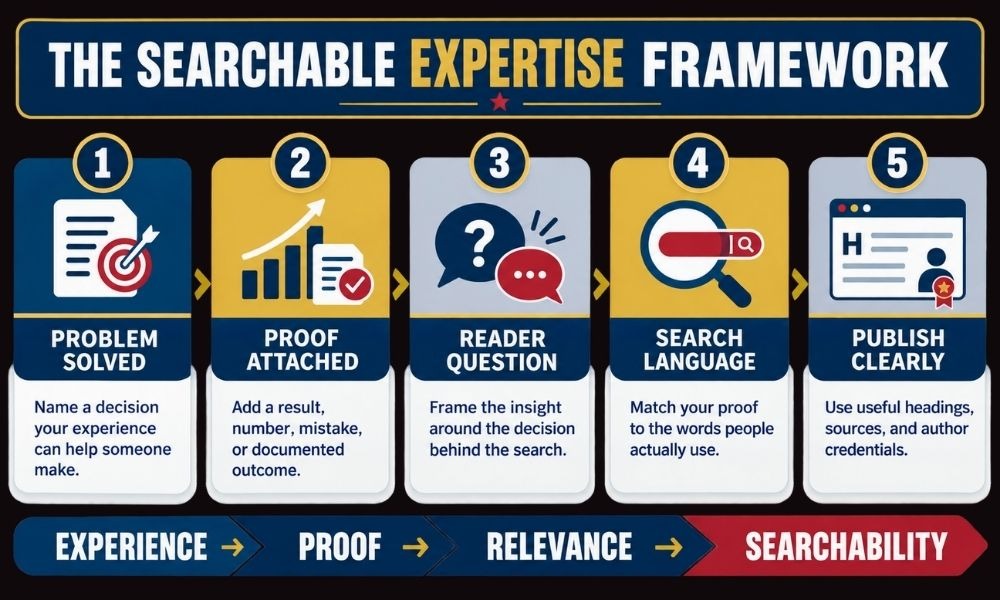
Turn a Claim Into Proof
This is the step most professionals skip. They state an opinion and move on. Search engines and readers both want the reasoning behind it.
Take a claim like “always audit vendor contracts before renewal.” On its own, that is advice anyone could type. Add proof and it becomes expertise:
- The situation: a mid-size manufacturer renewed a logistics contract without reviewing fuel surcharge clauses.
- The cost: a 14% increase they didn’t catch until the next quarterly report.
- The fix: a renewal checklist that flags variable-cost clauses 60 days before any contract expires.
Same advice, different weight. One version is a guess. The other is a documented decision.
If you’re unsure whether your evidence holds up, run it through a proper check before it goes live. I break down that process in why source verification needs its own content workflow.
Reason Through the Reader’s Actual Question
Once you have proof, connect it to the actual question behind the search. Readers rarely search for topics. They search for decisions.
“Vendor contract audit” is a topic. “Why did our vendor costs increase after renewal” is a decision someone is trying to reverse-engineer. Your content needs to answer the second version, using the first as a label.
Write toward the moment the reader is in:
- What did they just discover went wrong?
- What are they deciding between right now?
- What would make them trust your answer over the next five results?
Answer those, and the topic takes care of itself.
Match Your Proof to Real Search Terms
Now, and only now, bring in keyword research. Search data should confirm the language people use for a problem you can already solve, not hand you a topic you have to fake expertise on.
Use free tools like Google’s “People also ask” boxes and related searches to check phrasing. If your proof point involves “vendor contract audit” but people search “how to catch hidden vendor fees,” rewrite your headline and subheads around their words, not your internal jargon.
Your proof stays the same. Only the language shifts to match how people actually type the question.
How to Publish Searchable Expertise in a Format Google Can Verify
Structure decides whether your expertise gets read or skipped. Use:
- A clear H1 that states the topic in plain terms
- H2 subheads that match how people search, phrased as questions or decisions
- Short paragraphs, three to four sentences max
- A named author bio with credentials
- Outbound links to primary sources, not just other blogs quoting each other
Google‘s quality raters are trained to check for exactly this kind of transparency and sourcing when judging expertise and trust.[^2] Skipping author attribution or proof is one of the fastest ways to look low-effort, even when the underlying knowledge is strong.
Your Next Step
- List five problems you solved at work in the last year. That’s your raw material.
- For each one, write the specific outcome or number attached to it. No number, no proof.
- Search the exact phrase a stressed reader would type, not the internal term your industry uses.
- Add a real author bio with your name, role, and one credential.
- Publish one piece at a time. A single well-proven post beats five vague ones.
FAQ
Does searchable expertise require formal credentials or certifications?
No. Google’s quality raters accept demonstrated experience, documented outcomes, and hands-on knowledge as valid expertise signals, even without formal credentials, especially for topics where lived experience carries weight
How long does it take before search engines recognize expertise on a new site?
There’s no fixed timeline. It depends on how consistently you publish proof-backed content, how well your site handles technical basics, and how much competing content already covers the same ground. Sites publishing thin or generic posts wait far longer than sites publishing specific, sourced content.
Can AI-assisted writing still count as searchable expertise?
Yes, if the underlying knowledge and review are human. Google has stated that using AI in content creation does not by itself lower quality ratings. What matters is whether the final piece shows real expertise, accurate sourcing, and editorial review, not who typed the first draft.
Turning experience into content is only half the job. The other half is proving that content is worth trusting once it’s published. ReadThe Content Proof Gap: Why Your Best SEO Content Starts Before Writing for the proof-first framework I use with clients, or checkYour Website Can’t Carry Your Authority Alone if you’re relying on one page to do all the work.