
How to Find Content Gaps Inside Your Own Expertise
A content gap inside your own expertise is a question your audience asks that you can answer from direct experience, but your site has not covered yet. Find these gaps by listing the questions clients or readers actually send you, checking them against your published posts, and writing the ones missing. This method beats copying competitor topics because it produces content only you can write.
Most content gap advice sends you straight to competitor research. Check their site, run a tool, find what they missed. That method works, but it skips a bigger source of untapped material: content gaps inside your own expertise. These are the answers you already have in your head but have never put on a page. If you have worked in your field for even a year, you are sitting on knowledge your published content has not touched yet.
Why Look Inside Your Expertise Before You Look at Competitors
Competitor gap analysis tells you what topics exist in your niche. It does not tell you what you personally know that nobody else has written correctly.
Here is the problem with copying a competitor’s content map. You end up writing the same article they wrote, with your own words swapped in. Google’s own guidance on people-first content asks a direct question: does your content demonstrate first-hand expertise and depth of knowledge that only comes from having actually done the work? A competitor’s outline cannot answer that question for you.
I write for fintech and B2B clients. When I check competitor content first, I get a list of topics everyone already covers. When I check my own project notes first, I find the specific problems I solved that nobody wrote a clear answer for. That second list is where rankings and trust actually come from.
Decision to make here: start your next content audit with your own experience. Competitor research still matters, but it comes second.
What Problem Do Unwritten Answers Create For Your Readers
Every unanswered question on your site sends a reader somewhere else. That is the real cost of a content gap.
Think about your own inbox or comment section. Readers and clients ask you things your blog does not cover. Maybe they ask about edge cases, pricing scenarios, or mistakes you have seen other people make. If you have not written the answer down, three things happen:
- The reader leaves your site to find it elsewhere, often on a lower-quality page.
- You answer the same question by email or call, over and over, instead of once in writing.
- A competitor with less experience than you claims the topic first and ranks for it.
This is the problem your content plan needs to solve. Not “we need more blog posts.” You need the specific answers only your experience can give, written down before someone else writes a shallower version.
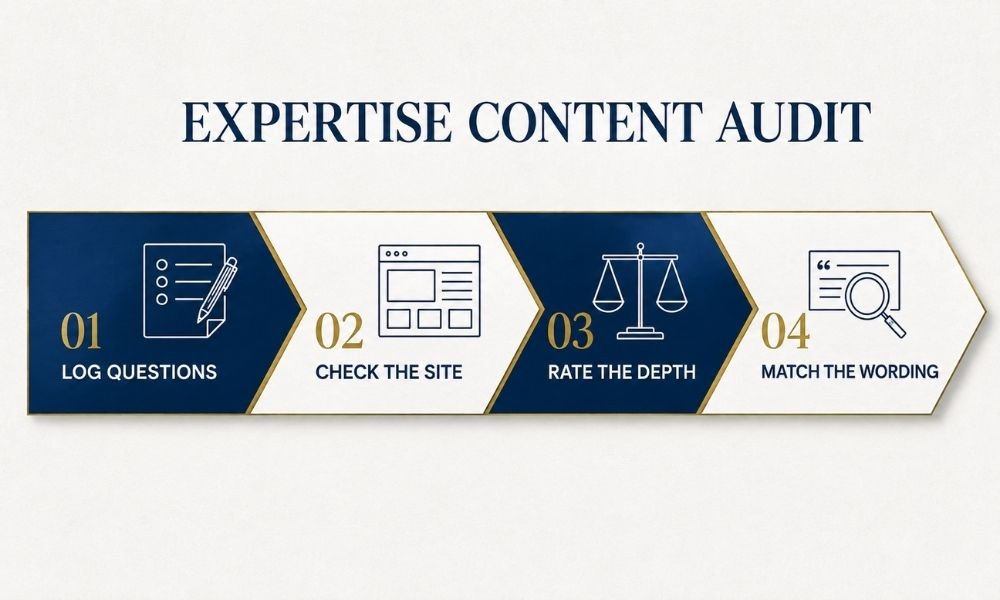
How to Audit What You Know That You Have Not Published
This is the reasoning step. You need a system, not a random brainstorm.
Step 1: Pull your own question log.
Go through emails, DMs, sales calls, and comments from the last six months. Write down every question a real person asked you about your field. Do not filter yet.
Step 2: Match each question against your published content.
Search your own site for the topic. If nothing comes up, or what comes up is thin, that is a gap.
Step 3: Rate each gap by how much first-hand detail you have.
Some questions you can answer in two sentences. Others you could write 1,500 words on because you have solved that exact problem five times. Prioritize the second kind. That depth is what separates your content from a generic explainer.
Step 4: Check the phrasing readers actually use.
People rarely ask questions in SEO-friendly language. A client might say “why did my ranking drop after I switched hosts” instead of “hosting migration SEO impact.” Write your headline and subheads using their words, not the formal version. This is the same principle behind mining customer language forwebsite copy.
Here is a simple table format to run this audit:
| Question From Readers | Currently Covered? | Depth of Your Experience | Priority |
| Why did rankings drop after a migration | No | High, handled 4 cases | Write first |
| Best CMS for a small team | Thin, 200-word mention | Medium | Update existing |
| How to price a first project | No | High | Write first |
How to Turn Raw Experience Into Publishable Coverage
Knowing a gap exists is not the same as covering it well. This is where most writers rush and produce something generic anyway.
To turn a gap into strong coverage, add proof a competitor cannot copy:
- Specific numbers. Not “many clients,” but “4 out of the last 6 migrations I handled.”
- A mistake you made. Readers trust admitted errors more than polished advice.
- A decision you would make differently now. This signals real experience, not summarized research.
- A short example or mini case. One real scenario beats three vague tips.
This matches what search quality guidelines reward. Google’s helpful content documentation states that content should show expertise, clear sourcing, and trustworthiness, and that pages built mainly to attract search traffic tend to get downgraded over pages built to genuinely help someone. Generic tips filled with keywords fail that test. Specific, lived detail passes it.
Once you draft the piece, check it against actual search intent for that question. If your outline does not match what already ranks, and your added detail does not go beyond it, revisit the intent before you publish.
How to Decide Which Gaps To Publish First
You will not have time to write every gap on your list at once. Order matters.
- Publish the high-frequency questions first. If five different clients asked the same thing last quarter, that gap has demand.
- Publish what connects to your existing content. A new post that links naturally into three older ones builds a stronger topic cluster than one that sits alone.
- Publish what you can prove. If you have data, screenshots, or a clear before-and-after, move that gap up the list.
- Hold off on gaps you cannot back with detail yet. A thin post on a good topic still reads as thin.
Block 30 minutes this week. Pull your last 20 client or reader questions. Search your own site for each one. Anything missing or thin goes on next month’s content calendar, ranked by how much real experience you have to back it.
FAQ
How is a content gap inside your expertise different from a keyword gap?
A keyword gap tool tells you which search terms your site does not rank for. It works off search volume data, not what you actually know. A content gap inside your expertise starts from your own experience and only checks search demand afterward. The two overlap sometimes, but a keyword gap can point you toward a topic you cannot answer with any real depth.
How often should you repeat this audit?
Run the question log check every quarter. Client questions shift as your industry changes, and a gap you filled a year ago might need an update rather than a new post. Quarterly reviews catch both new gaps and content that has gone stale.
Can a beginner with limited experience still find content gaps this way?
Yes, but the source changes. Instead of years of client work, pull from your own learning process. Write down the questions you had to research hardest to answer for yourself. Those are the gaps a newer audience member is likely searching for right now, and you have fresh memory of exactly where the confusion was.
Write What Only You Can Prove
Competitor research shows you what exists. Your own expertise shows you what is missing. Run both, but start with the one only you can do.
If you want the next step, read how to match your drafts to search intent before you publish, or build your gap list into a full topic cluster so each new post supports the last.