
Brand Voice vs. Brand Point of View: What’s the Difference?
Brand voice is how you sound. Brand point of view is what you believe. Voice is your personality on the page (word choice, rhythm, humor). Point of view is your stance on a topic in your industry, the opinion you’re willing to defend. You need both. Voice without a point of view sounds pleasant and says nothing. A point of view without a consistent voice reads like a different person wrote each article.
Most brands confuse brand voice and brand point of view, and it shows in their content. One brand sounds friendly on every page but never takes a position on anything. Another brand has strong opinions but writes them in five different tones depending on who’s typing that day. Neither approach builds the kind of trust that gets a piece of content shared, bookmarked, or linked to.
This guide breaks down the real difference, why the mix-up hurts your search visibility, and how to fix it in your next content sprint.
What Is Brand Voice?
Brand voice is your writing personality. It covers:
- Sentence length and rhythm
- Formality level (casual vs formal)
- Word choice (do you say “buy” or “grab”?)
- Humor, or the absence of it
- How you address the reader (second person, first person, neither)
Voice stays the same across a product page, a blog post, and a customer email. If you strip the logo off three pages and readers can still guess it’s you, your voice is working.
What Is a Brand Point of View?
Point of view is the opinion behind the words. It’s the position you take on a debate in your field.
Inkbot Design’s 2026 content strategy analysis makes the case directly: as AI floods the web with technically correct but characterless articles, brands that stand apart are the ones with a defined point of view, a recognizable voice, and the discipline to keep both consistent across every piece they publish. That’s not a branding nicety. It’s a ranking and trust strategy.
The Content Marketing Institute backs this up from its own research. In its 2026 trends roundup, CMI research director Lisa Murton Beets points to authenticity as a differentiator in an AI-saturated landscape, and argues that interviews, behind-the-scenes stories, and expert insights are what set brands apart when AI content is everywhere.
A point of view answers questions like:
- Do you think keyword density still matters, or is it outdated advice?
- Do you recommend AI-assisted drafts, or do you push back on them?
- What do you believe your competitors get wrong?
Skyword’s research on content perspective points out something practical here too: the pronoun you choose (first, second, or third person) often reflects a decision that’s already been made about how the brand wants to frame its stance. Point of view isn’t just opinion. It shows up in grammar choices too.
Brand Voice vs. Brand Point Of View: Where They Actually Differ
| Brand Voice | Brand Point of View | |
| What it is | How you sound | What you believe |
| Changes over time? | Rarely | Can evolve with new data |
| Where it lives | Word choice, tone, structure | Opinions, stances, recommendations |
| What breaks it | Inconsistent tone across writers | Playing it safe on every topic |
| Reader impact | Recognition | Trust and authority |
Voice makes you recognizable. Point of view makes you worth reading.
Why Mixing These Up Costs You Rankings and Trust
Google’s helpful content guidance rewards pages that show real experience and a clear perspective, not pages that repeat the same five talking points as every competitor. If your content has voice but no point of view, it reads like generic advice with better adjectives. Readers bounce. Google notices the bounce.
If you have a point of view but no consistent voice, readers can’t tell if the strong opinion in one article came from the same source as the vague hedge in another. That inconsistency erodes the trust signal you’re trying to build with E-E-A-T (Experience, Expertise, Authoritativeness, Trust).
Here’s the pattern I see most in client audits:
- A business hires three different writers over a year.
- Each writer has their own default tone.
- Nobody documents the brand’s actual stance on industry debates.
- The blog reads like three separate publications stitched together.
That’s a coverage problem and a trust problem at the same time.
How to Build Both Into Your Content Strategy
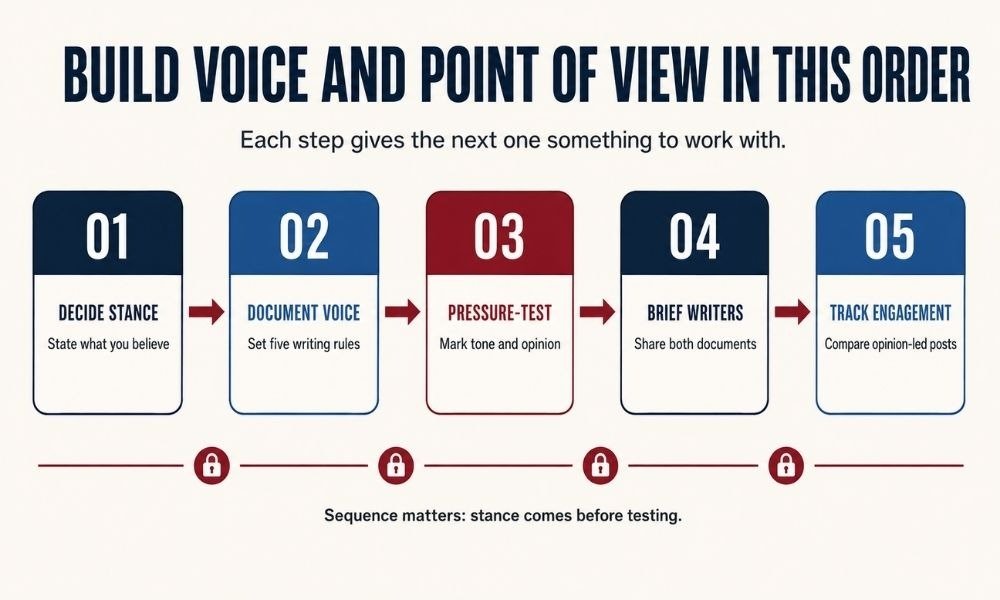
Fix voice and point of view in this order. Each step depends on the last.
1. Decide your stance first, not your tone. Before you write a single headline, list five debates in your industry. For each one, write one sentence stating where you stand. This becomes your point of view bank.
2. Document your voice in five rules. Not a 20-page style guide nobody reads. Five rules: sentence length preference, formality level, pronoun use, humor level, words you never use. Keep it on one page.
3. Pressure-test both against a real article. Take one published post. Mark every sentence that sounds like your voice. Mark every sentence that states an actual opinion instead of a neutral summary. If most sentences are neutral summaries, your point of view isn’t showing up yet.
4. Brief every writer with both documents. Voice guide plus point of view bank, every time. This is what keeps a three-writer team sounding like one publication.
5. Publish, then track engagement on opinion-driven posts vs neutral ones. Compare time on page and shares. Opinion-driven content usually wins here, because it gives readers something to agree or disagree with.
A Quick Example You Can Steal
Take the topic “Should you use AI to write blog intros?”
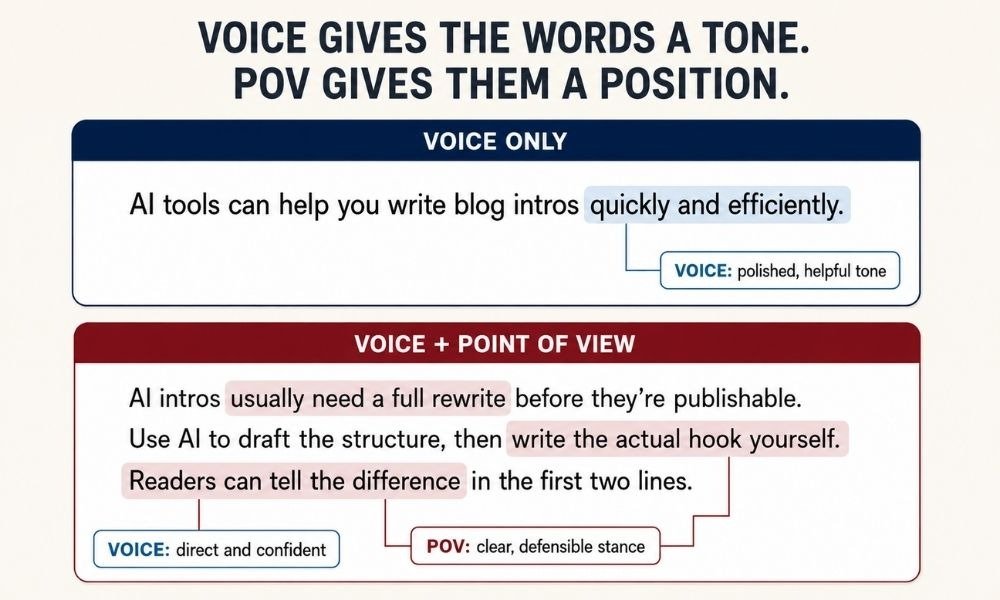
- Voice-only version: “AI tools can help you write blog intros quickly and efficiently.” (Sounds fine. Says nothing.)
- Voice + point of view version: “AI intros usually need a full rewrite before they’re publishable. Use AI to draft the structure, then write the actual hook yourself. Readers can tell the difference in the first two lines.”
Same voice, second version has a stance. That’s the difference that gets a piece bookmarked instead of skimmed.
Your Next Step
- Write your five voice rules on one page today.
- List five industry debates and state your stance on each, in one sentence.
- Audit your last three blog posts for neutral summaries disguised as advice.
- Brief every freelancer or team member with both documents before they draft.
FAQ
Can a brand have a strong voice without a clear point of view?
Yes, and it’s common with newer businesses still gathering data on their industry. It works short-term for brand recognition, but it caps how much authority you build. Readers remember how you sound before they trust what you say
Does brand point of view change with every content update or algorithm shift?
Your core stance shouldn’t flip every time a trend shifts. It can evolve when you get new data or direct experience that changes your recommendation, but constant flip-flopping reads as indecision, not growth.
How many writers can maintain one brand voice on a team?
Any team size works if the voice guide is specific enough. The failure point isn’t team size, it’s vague documentation. A five-rule voice guide keeps ten writers consistent. A vague one breaks down with two.
Keep Building Your Content Strategy
If you’re fixing point of view and voice, your keyword targeting and search intent mapping need the same attention. Read Search Intent for Content Writers: A Clear Guide next to make sure your opinions are landing on the right pages.
Using AI to draft your point-of-view content? Check How to Make AI Content Sound Human Without Losing SEO before you publish.
Need a content partner who documents your voice and builds your point of view bank from scratch? Get in touch.