Search Intent for Content Writers: A Clear Guide
You write well-researched, grammatically perfect articles that fail to rank. You spend hours crafting clever introductions and detailed backstories, yet traffic remains flat. This is not a quality issue. It is an alignment issue.
Readers in 2026 do not have time for nuance when they want a definition. They do not want a story when they are looking to buy software. If you misjudge the “why” behind the search, the “what” in your content does not matter.
This guide fixes that disconnect. It moves you from guessing to engineering content that ranks because it actually solves the specific problem the user came to solve.
What Search Intent Actually Means
Search intent is the goal the user has in mind when typing a query. It is not just about the topic. It is about the format of the answer.
In 2026, intent goes beyond traditional keywords. With the rise of Answer Engine Optimization (AEO) and generative search, intent dictates whether a user gets a quick summary, a comparison table, or a deep-dive tutorial.
If a user searches for “best CRM for startups,” they are in a commercial mindset. They want a list, pricing, and pros/cons. If you give them a 2,000-word essay on the history of customer relationship management, you have failed the intent check. Google and AI search tools will bypass your content for a competitor who got straight to the point.
According to 2025 search behavior reports, over 60% of searches now end without a click to a website if the immediate answer is provided on the results page. This means your content must be structured to answer the core question immediately to capture the remaining high-intent clicks.
The Four Types of Intent (And How to Handle Them)
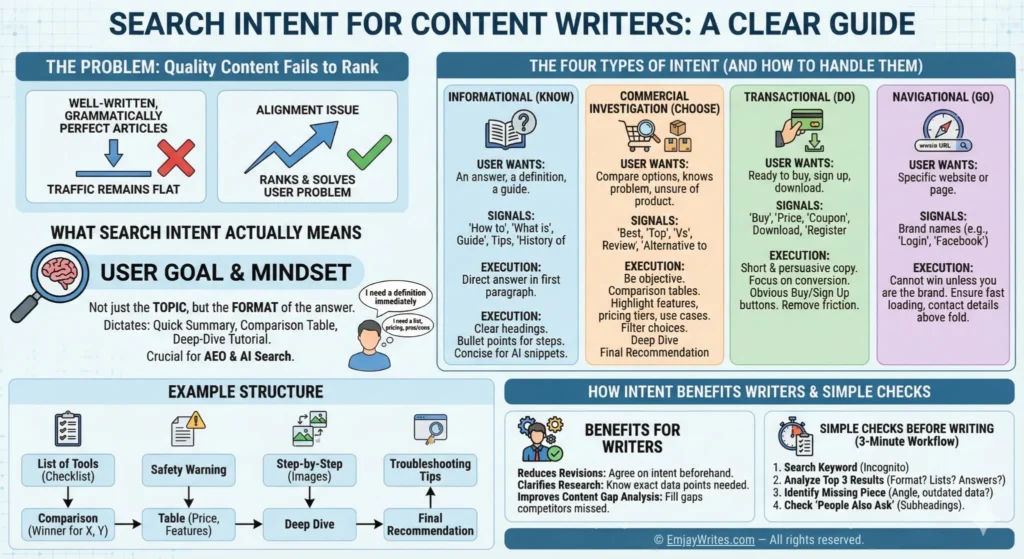
Most queries fall into four buckets. Recognizing these instantly is a core skill for any strategist or writer.
1. Informational Intent (Know)
The user has a question. They want an answer, a definition, or a guide.
- The Signal: “How to,” “What is,” “Guide,” “Tips,” “History of.”
- Your Execution: Provide the direct answer in the first paragraph. Use clear headings. Use bullet points for steps. Do not bury the solution. If writing for AEO, ensure your answer is concise enough for an AI snippet to grab.
2. Commercial Investigation (Choose)
The user knows they have a problem and believes a product can fix it, but they are not sure which one yet. They are comparing options.
- The Signal: “Best,” “Top,” “Vs,” “Review,” “Alternative to.”
- Your Execution: Be objective. Use comparison tables. Highlight specific features, pricing tiers, and use cases. Your authority comes from helping them filter their choices, not just selling one hard.
3. Transactional Intent (Do)
The user is ready to buy, sign up, or download. They know what they want.
- The Signal: “Buy,” “Price,” “Coupon,” “Download,” “Register.”
- Your Execution: Keep copy short and persuasive. Focus on conversion. Make the “Buy” or “Sign Up” button obvious. Remove friction. This is often where copywriting skills matter more than long-form content production.
4. Navigational Intent (Go)
The user is looking for a specific website or page.
- The Signal: Brand names (e.g., “Login,” “Facebook,” “Emjay Writer contact”).
- Your Execution: You usually cannot “win” these keywords unless you are the brand. If you are writing for that brand, ensure the page loads fast and the login/contact details are above the fold.
How Intent Guides Structure
Once you identify the intent, the structure writes itself. This removes the “blank page” paralysis.
Scenario A: “How to fix a leaky faucet” (Informational)
Structure:
- List of tools needed (checklist).
- Safety warning.
- Step-by-step instructions with images.
- Troubleshooting tips.
Why: The user is holding a wrench. They do not want an introduction about the history of plumbing.
Scenario B: “Asana vs. Monday.com” (Commercial)
Structure:
- Quick verdict (winner for X, winner for Y).
- Comparison table (price, features).
- Deep dive into specific differences.
- Final recommendation based on company size.
Why: The user has a credit card ready but fears making the wrong choice. They need reassurance and data.
How Intent Helps Writers
Focusing on intent is not just good for SEO. It protects your sanity and improves your workflow.
- Reduces Revisions: When you agree on the intent with a client or editor beforehand, you avoid the “this isn’t what I imagined” feedback loop.
- Clarifies Research: You know exactly what data points you need. If it is informational, you need facts. If it is commercial, you need specs and pricing.
- Improves Content Gap Analysis: You can spot where competitors failed to answer the specific intent and fill that gap with your content.
Simple Checks Before Writing
Before you write a single word of your draft, perform this three-minute check. I use this workflow for everything from Fintech technical writing to commercial insurance pitches.
- Search the Keyword: Open an incognito window. Type your target keyword.
- Analyze the Top 3 Results:
- Are they blogs, product pages, or calculators?
- Do they use lists or heavy paragraphs?
- What questions do they answer immediately?
- Identify the Missing Piece: What did the top results miss? Is the data outdated? Is the language too complex? That is your angle.
- Check the “People Also Ask” Box: This tells you the immediate follow-up questions the user has. Include these as subheadings.
Next Step
Open your current content calendar or a draft you are working on. Look at the primary keyword. Google it now. Does the structure of your draft match the structure of the top ranking results? If not, adjust your outline before you write another sentence.