The Complete Guide to Website Copywriting (2026 Edition)
Your website has a traffic problem, but it is not the one you think. You likely have visitors. You might even have decent click-through rates from your ads. The problem is that once they arrive, they leave.
They bounce because your copy fails to answer their primary question in under three seconds: “What is in this for me?”
In 2026, the digital landscape is unforgiving. Users do not read; they hunt. They scan for keywords that match their internal intent. If they do not find them immediately, they retreat to the search results or ask an AI agent to summarize a competitor’s site instead.
This guide is not about creative writing. It is not about being clever. It is about engineering text that converts traffic into revenue.
The New Reality: Copywriting in the Age of Answer Engines

The old playbook of stuffing keywords for Google is dead. In 2026, we optimize for Information Gain and Semantic Clarity.
Gartner predicted that organic search traffic would drop by 25% by 2026 as users shift toward generative AI solutions. This prediction has largely come true. Users now get their answers directly on the search results page or through chat interfaces.
This means when a user actually clicks through to your website, their intent is higher than ever. They are not looking for basic definitions. They are looking for specific solutions, deep expertise, or a transaction. Your copy must respect this shift. You can no longer afford to be vague.
The “Information Gain” Standard
Search engines and AI models now prioritize content that adds new information to the web rather than regurgitating existing articles. If your website copy looks exactly like your competitor’s, you will be buried.
How to apply this:
- Original Data: efficient copy cites internal data or case studies.
- Contrarian Viewpoints: Take a stand against common industry advice.
- Experience-Based Nuance: Explicitly state how you solved a problem, not just that you can solve it.
Phase 1: The Research (Before You Write a Single Word)
Amateur writers start by typing. Professional strategists start by mining. You cannot write high-converting copy if you do not know the specific language your customers use to describe their pain.
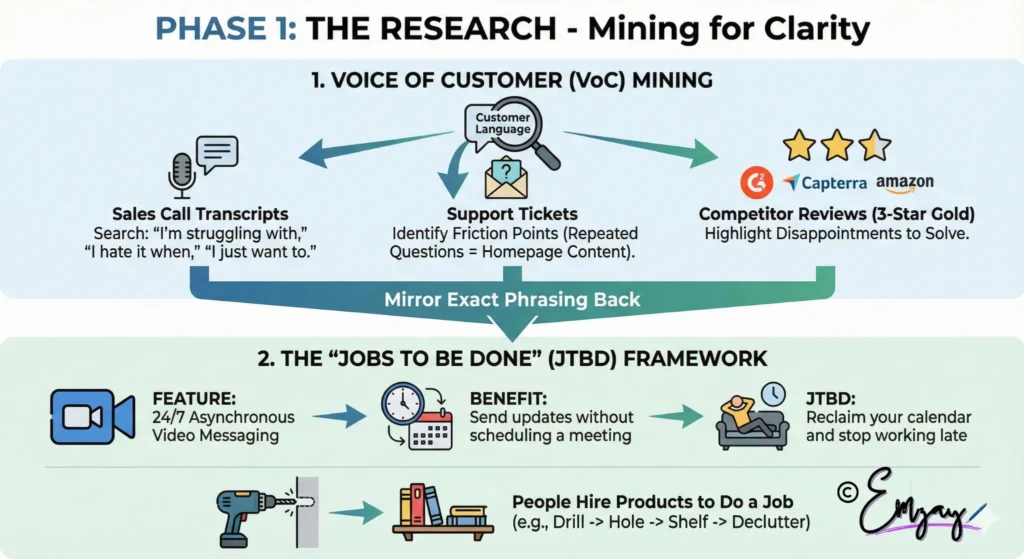
1. Voice of Customer (VoC) Mining
Your customers explain their problems better than you do. Your job is to find their exact phrasing and mirror it back to them.
Where to look:
- Sales Call Transcripts: Use tools to transcribe sales calls. Search for phrases like “I’m struggling with,” “I hate it when,” or “I just want to.”
- Support Tickets: Look for friction points. If five users ask the same question, that question belongs on your homepage.
- Competitor Reviews: Go to G2, Capterra, or Amazon. Read the 3-star reviews of your competitors. The 3-star reviews are gold because they highlight specific disappointments you can promise to solve.
2. The “Jobs to Be Done” (JTBD) Framework
People do not buy products; they hire them to do a job. A drill is hired to make a hole. A hole is hired to hang a shelf. A shelf is hired to declutter a room.
The Copy Translation:
- Feature: “We offer 24/7 asynchronous video messaging.”
- Benefit: “Send updates to your team without scheduling a meeting.”
- JTBD: “Reclaim your calendar and stop working late.”
Phase 2: The Homepage and Hero Section
You have less than three seconds to buy more time. The top of your homepage (the Hero Section) is the most valuable real estate on the internet.
The Value Proposition Formula
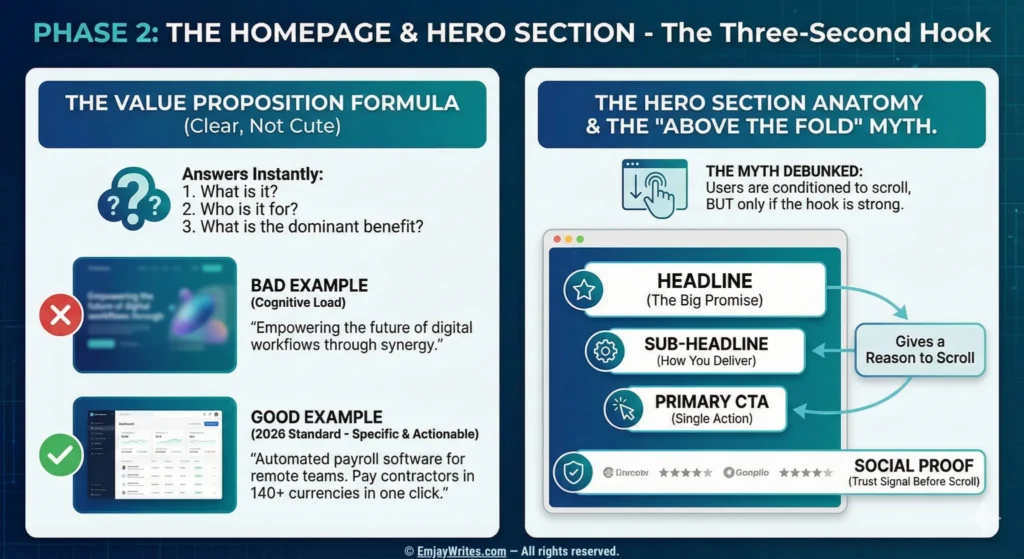
Do not try to be cute. Be clear. A strong value proposition answers three questions instantly:
- What is it?
- Who is it for?
- What is the dominant benefit?
Bad Example: “Empowering the future of digital workflows through synergy.” (This means nothing. It creates cognitive load.)
Good Example (2026 Standard): “Automated payroll software for remote teams. Pay contractors in 140+ currencies in one click.” (Specific. Actionable. Clear audience.)
The “Above the Fold” Myth
Marketers used to panic about keeping everything “above the fold” (visible without scrolling). In 2026, we know users are conditioned to scroll. However, they will only scroll if the initial hook gives them a reason to.
Your Hero Section must include:
- Headline: The big promise.
- Sub-headline: The explanation of how you deliver the promise.
- Primary CTA: The single action you want them to take.
- Social Proof: A trust signal (logo, rating, or stat) visible before the scroll.
Phase 3: Structuring Body Copy for Scanners
Wall-of-text paragraphs kill conversions. Modern reading behavior is non-linear. Users pinball around the page looking for headers that are relevant to them.
The Cognitive Load Reduction Strategy
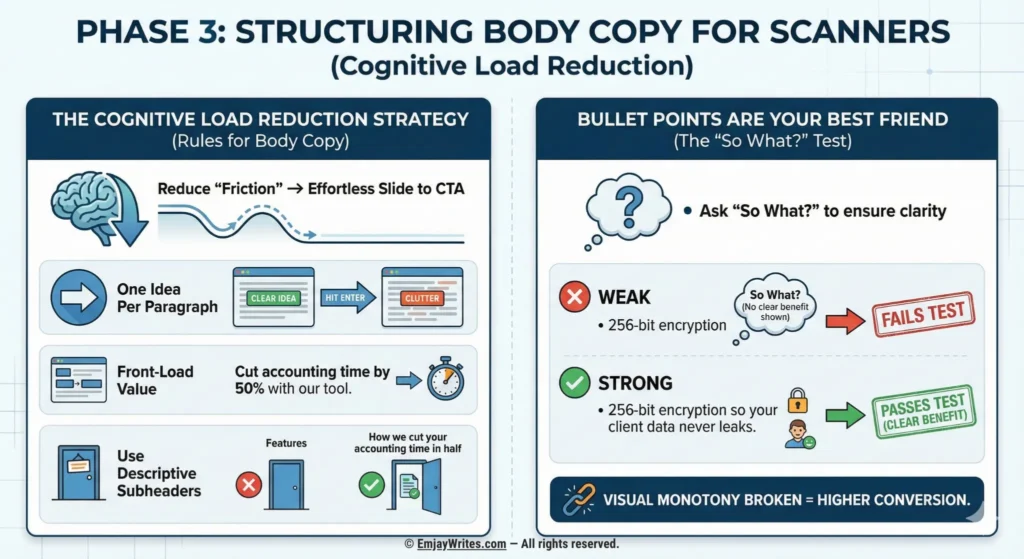
Every unnecessary word adds “friction” to the user’s brain. Your goal is to reduce friction until the slide to the CTA is effortless.
Rules for Body Copy:
- One idea per paragraph: If you introduce a second idea, hit “Enter.”
- Front-load value: Put the most important words at the start of the sentence.
- Use descriptive subheaders: Never use generic headers like “Features” or “Benefits.” Instead, use “How we cut your accounting time in half.”
Bullet Points Are Your Best Friend
Bullet points break up visual monotony. But most writers use them incorrectly.
The “So What?” Test for Bullets: Read your bullet point. Ask “So what?” If the answer is not in the text, rewrite it.
- Weak: “256-bit encryption.”
- Strong: “256-bit encryption so your client data never leaks.”
Phase 4: High-Value Page Breakdowns
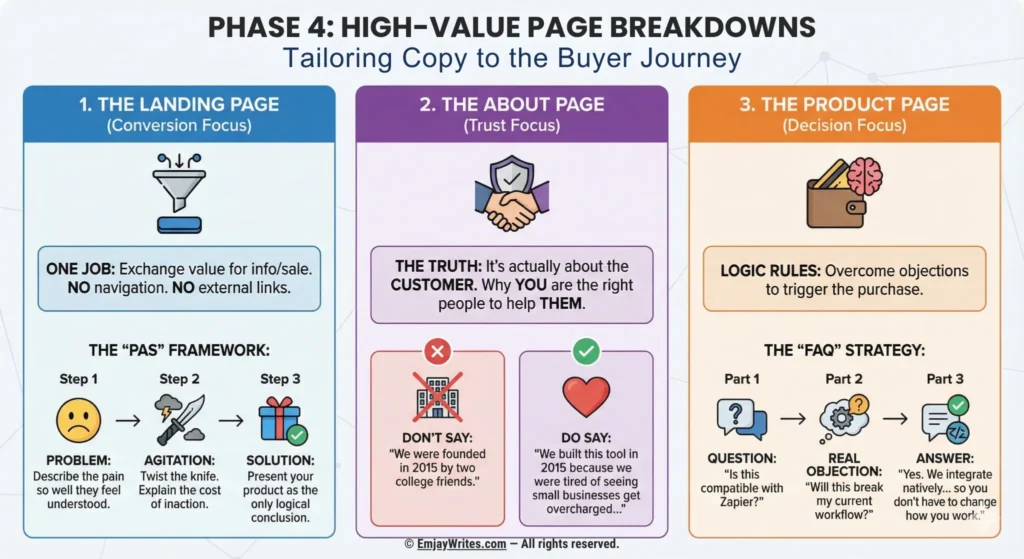
Different pages serve different stages of the buyer journey. You cannot treat an “About” page like a “Landing” page.
1. The Landing Page (Conversion Focus)
This page has one job. It should not have a navigation bar. It should not have links to your blog. It exists to exchange value for contact information or a sale.
The “PAS” Framework:
- Problem: Describe the pain so well the user feels understood.
- Agitation: Twist the knife. Explain the cost of leaving the problem unsolved.
- Solution: Present your product as the only logical conclusion.
2. The About Page (Trust Focus)
This is the second most visited page on many B2B sites. The biggest mistake companies make is making the About page about themselves.
The Truth: The About page is actually about the customer. It is about why you are the right people to help them.
- Don’t say: “We were founded in 2015 by two college friends.”
- Do say: “We built this tool in 2015 because we were tired of seeing small businesses get overcharged for payment processing.”
3. The Product Page (Decision Focus)
This is where the wallet comes out. Logic rules here. You need to overcome objections.
The “FAQ” Strategy: Use your FAQ section to handle objections, not just answer questions.
- Question: “Is this compatible with Zapier?”
- Real Objection: “Will this break my current workflow?”
- Answer: “Yes. We integrate natively with Zapier so you don’t have to change how you work.”
Phase 5: Microcopy and UX Writing
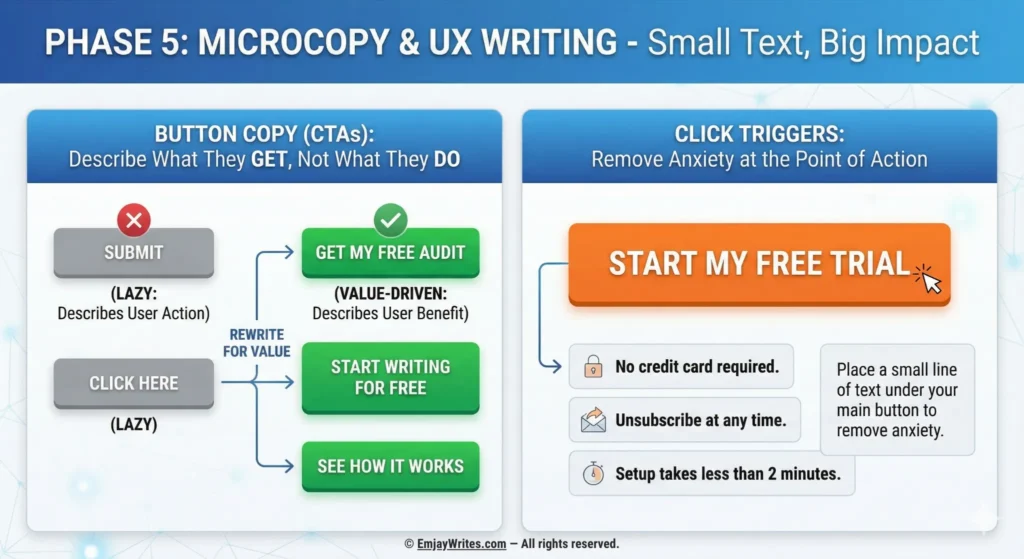
Microcopy is the small text on buttons, error messages, and forms. It has a disproportionate impact on conversion rates because it occurs at the point of action.
Button Copy (CTAs)
“Submit” and “Click Here” are lazy. They describe what the user does, not what they get.
Rewrite for Value:
- Instead of “Submit,” try “Get My Free Audit.”
- Instead of “Sign Up,” try “Start Writing for Free.”
- Instead of “Learn More,” try “See How It Works.”
Click Triggers
Place a small line of text under your main button to remove anxiety. This is called a “click trigger.”
Examples:
- “No credit card required.”
- “Unsubscribe at any time.”
- “Setup takes less than 2 minutes.”
Phase 6: SEO in the Era of Generative AI
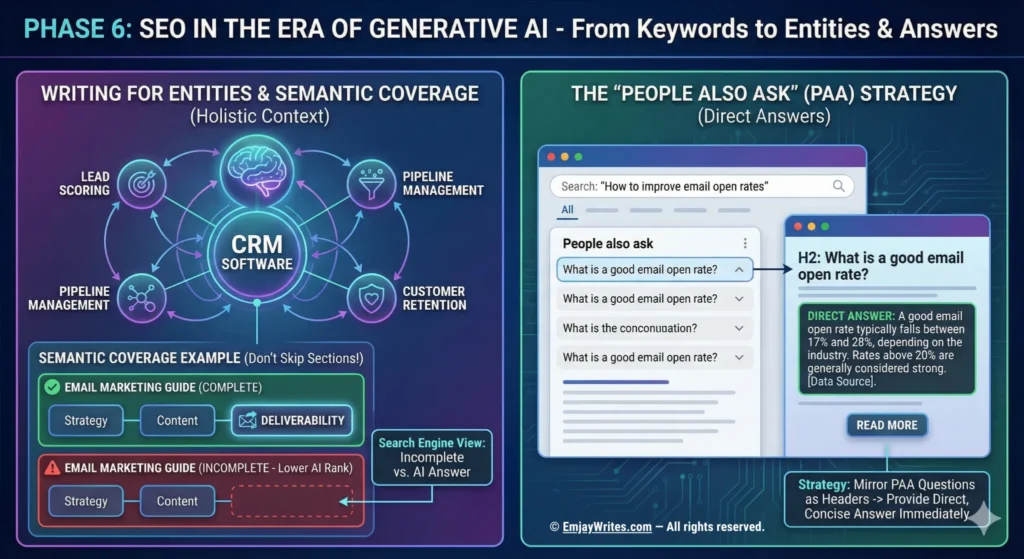
We briefly touched on this, but let’s go deeper. Writing for SEO in 2026 is about writing for entities, not just strings of keywords.
Search engines now understand the relationship between concepts. If you are writing about “CRM Software,” the AI expects you to also cover related entities like “lead scoring,” “pipeline management,” and “customer retention” within the same context.
Semantic Coverage
Do not just sprinkle keywords. Cover the topic holistically. If you write a guide on “Email Marketing,” you must include a section on “Deliverability.” If you skip it, the search engine views your content as incomplete compared to the AI-generated answer.
The “People Also Ask” Strategy
Look at the “People Also Ask” box in search results. These are the exact questions your users are typing. Your headers should mirror these questions, and your body text should provide the direct answer immediately following the header.
Phase 7: The Human-AI Hybrid Workflow
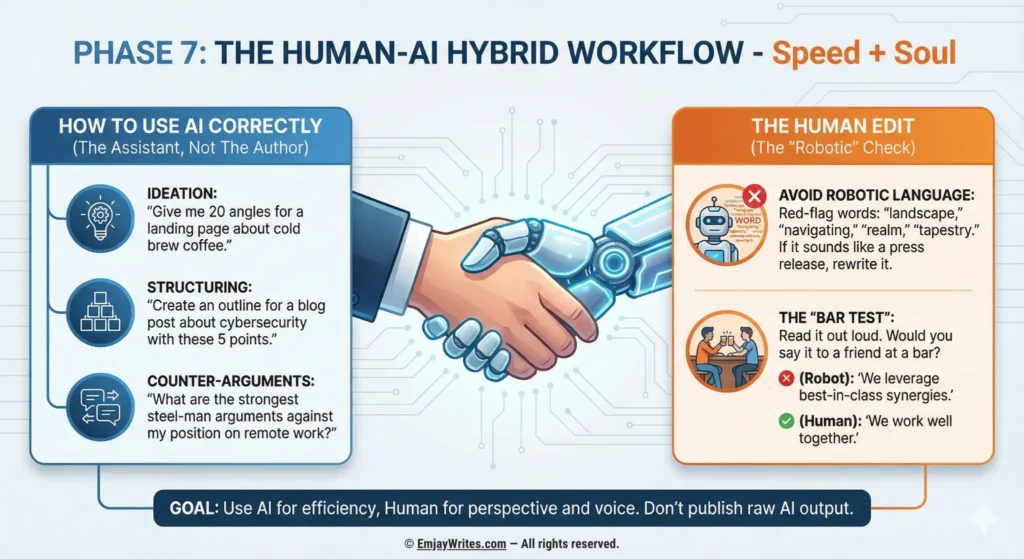
You should be using AI to speed up your workflow. You should not be using AI to write your final draft. AI writing is often verbose, repetitive, and lacks a strong point of view.
How to Use AI Correctly
- Ideation: “Give me 20 angles for a landing page about cold brew coffee.”
- Structuring: “Create an outline for a blog post about cybersecurity that covers these 5 key points.”
- Counter-arguments: “I am arguing that remote work is better. What are the strongest steel-man arguments against my position?”
The Human Edit (The “Robotic” Check)
AI overuse of words like “landscape,” “navigating,” “realm,” and “tapestry” is a dead giveaway. If your copy sounds like a press release, rewrite it.
The “Bar Test”: Read your copy out loud. If you wouldn’t say it to a friend at a bar, do not put it on your website. No one says, “We leverage best-in-class synergies.” They say, “We work well together.”
Phase 8: Testing and Iteration
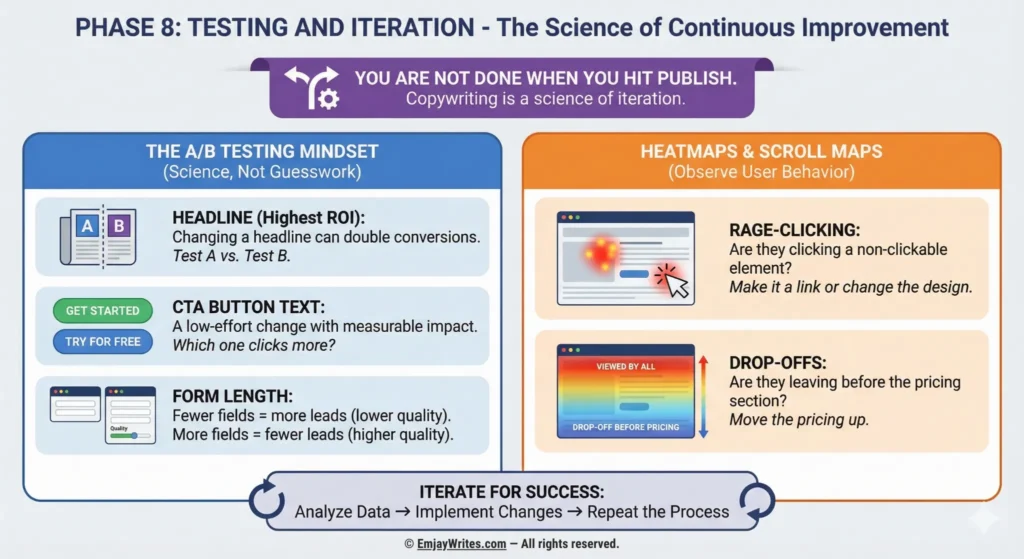
You are not done when you hit publish. Copywriting is a science of iteration.
The A/B Testing Mindset
You cannot guess what will work. You must test.
High-Impact Tests:
- Headline: This offers the highest ROI. Changing a headline can double conversions.
- CTA Button Text: A low-effort change with measurable impact.
- Form Length: Test removing fields. Usually, fewer fields equal more leads, but lower quality. More fields equal fewer leads, but higher quality.
Heatmaps and Scroll Maps
Install a tool like Hotjar or Microsoft Clarity. Watch where people click.
- Are they rage-clicking on a non-clickable element? Make it a link or change the design.
- Are they dropping off before the pricing section? Move the pricing up.
Final Thoughts: Clarity is the Only Metric
In 2026, attention is the scarcest resource. Your competitors are noisy. AI content is flooding the zone with mediocrity.
The way you win is by respecting your user’s time. Write with precision. Cut the fluff. Focus entirely on solving the problem they came to you to solve.
Great copywriting is about being the most understandable.
Next Step
Open your company’s homepage right now. Read the headline. Does it explicitly state what you do and what the user gets? If it relies on buzzwords like “solution,” “empower,” or “future,” rewrite it immediately using the formulas above.