
Topic Clusters for Digital Marketing: Simple Structure
Most content strategies fail because they rely on “shotgun blogging.” You publish random articles hoping one sticks, but in 2026, search engines and AI answer engines do not value isolated pieces of content. They value topical authority. If your site has fifty unrelated posts, Google and AI models view you as a generalist. If you have fifty interlinked posts covering every angle of a single subject, you become the entity they cite.
This shift is quantifiable. A 2025 study on AI Overview inclusion found that higher-ranking pages, often those supported by strong internal linking structures, are featured more frequently in AI summaries, while sites lacking this depth often see traffic erode to zero-click answers.
Here is how to structure topic clusters effectively to build that authority.
The Core Concept: Hub and Spoke
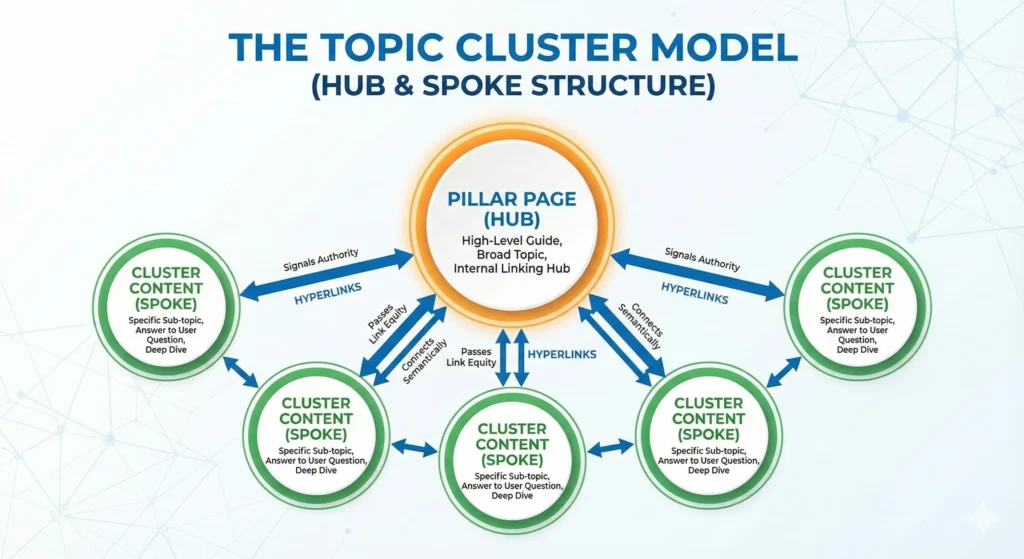
A topic cluster is not a list of keywords. It is a semantic architecture that tells search engines exactly what you are an expert in. It consists of three distinct parts:
- The Pillar Page (The Hub): A broad, high-level resource that covers a main topic comprehensively but leaves room for deep dives.
- The Cluster Content (The Spokes): Specific, highly focused articles that address individual sub-topics or long-tail questions related to the pillar.
- Hyperlinks: The internal linking structure that connects the spokes to the hub and the spokes to each other.
Without the linking, you just have a lot of content. The links transform the separate pages into a unified engine of authority.
How the Architecture Works
Search engines use semantic understanding to determine the relationship between pages. When you link ten specific articles back to one central pillar, you signal that the pillar is the most important resource on that topic.
Simultaneously, the authority flows both ways. The specific clusters lend depth to the broad pillar, and the high-traffic pillar passes link equity down to the specific clusters. This structure helps you rank for competitive short-tail keywords (via the pillar) and specific high-intent long-tail keywords (via the clusters).
Selecting Your Core Topic (Pillar)
Your core topic must be broad enough to generate volume but specific enough to be relevant to your product or service.
The Criteria:
- Search Volume: It needs substantial monthly search interest.
- Depth: It must be broad enough to spawn at least 10 to 20 sub-topics. If you can answer everything in 800 words, it is a blog post, not a pillar.
- Business Relevance: It must align with your core offer. Ranking for “productivity tips” is useless if you sell accounting software.
Example:
- Bad Core Topic: “How to pay taxes.” (Too specific, likely a cluster page).
- Bad Core Topic: “Finance.” (Too broad, impossible to rank).
- Good Core Topic: “Small Business Tax Compliance Strategies.” (Broad, high value, allows for many sub-topics).
Building Supporting Topics (Cluster Pages)
Once the pillar is defined, you build the spokes. These are not general overviews; they are specific answers to specific problems. In 2026, these pages are critical for AEO (Answer Engine Optimization) because AI models pull specific answers from these deep-dive pages.
Drafting Spoke Topics:
- Identify Questions: Use tools or sales calls to find the exact questions users ask.
- Focus on Intent: Each spoke should satisfy a distinct user intent (informational, transactional, or navigational).
- Avoid Cannibalization: Ensure no two spokes cover the exact same ground. “Tax software for LLCs” and “Best LLC tax tools” are likely the same article. Merge them.
A Practical Example: Fintech
To visualize this, look at how a B2B Fintech company would structure a cluster around “Invoice Factoring.”
The Pillar Page:
- Title: The Executive Guide to Invoice Factoring
- Content: What it is, pros/cons, how it compares to traditional loans, and who it is for.
The Cluster Pages (Spokes):
- Invoice Factoring vs. Bank Loans: A Cost Comparison
- How to Qualify for Factoring with Bad Credit
- Spot Factoring vs. Contract Factoring
- Accounting Treatment for Factored Invoices
- Risks of Non-Recourse Factoring
Each of those five pages links back to the “Executive Guide” using the anchor text “Invoice Factoring.” The “Executive Guide” links out to these pages when mentioning those specific sub-sections.
Implementation Next Steps
Stop writing random articles. Audit your existing content and group them into potential clusters. Identify the missing “Hub” pages that can tie your existing isolated articles together.