
The Content Proof Gap: Why Your Best SEO Content Starts Before Writing
Original content starts before anyone opens a draft. It starts in the notes most businesses forget to save, the questions people keep asking, the details that come up in meetings, and the patterns the team already knows from doing the work. That is the part most content misses.
I see this often with business owners, consultants, agencies, and professionals. They want stronger visibility, so they ask for blogs, LinkedIn posts, newsletters, and thought leadership. The request sounds clear, but the input is usually too thin.
A topic alone is not enough. A keyword is not enough. A competitor article is not enough. Those things give direction, but they rarely give the content a reason to exist.
That is where the content proof gap shows up.
What The Content Proof Gap Means
The content proof gap is the distance between what a business knows and what its content actually shows. A business may have years of client conversations, project lessons, buyer concerns, referral patterns, and internal opinions. Then the final blog still reads like it came from a public summary of the topic.
That happens because the strongest source material stays inside the business. It lives in calls, proposals, project notes, follow-ups, reviews, and team conversations. The writer only gets the surface brief, so the final content stays on the surface too.
This is why many websites sound correct but forgettable. The grammar is clean. The structure works. The SEO basics are there. Still, nothing in the article tells the reader why this business has a useful point of view.
Strong Content Needs Business Evidence
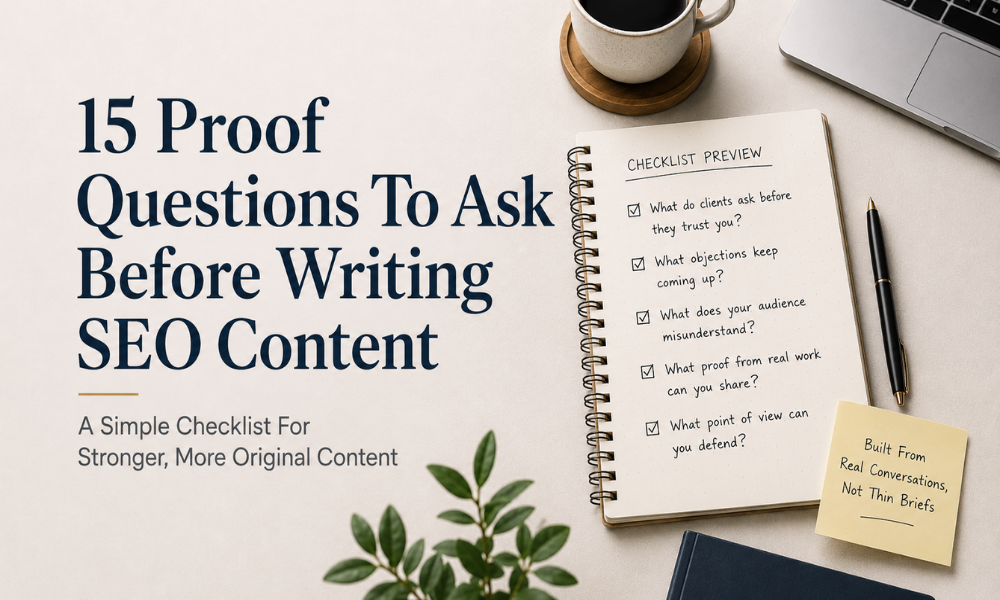
Before I write a serious content piece, I want to know what the business has already seen. What questions keep coming up? What do people misunderstand? What does the team explain in almost every call? What does the owner believe after years of doing the work?
That is where useful content starts. It gives the article context, weight, and a point of view. It also helps the content sound like it belongs to a real business with actual experience.
Google’s own AI Search guidance points in the same direction. It says SEO fundamentals still matter for generative AI features, and it puts clear emphasis on unique, helpful, expert-led content that adds value beyond common knowledge.
That matters because common knowledge is easy to produce now. Anyone can publish a basic explanation. The harder part is saying something specific, useful, and tied to real experience.
The Problem With Keyword-First Briefs
Keyword research still has a place. I use it for direction, search intent, and content planning. The problem starts when the keyword becomes the whole strategy.
A keyword can show that people search for content strategy. It cannot show why a consultant feels invisible even after posting every week. It cannot show why a business owner distrusts SEO content because every past blog sounded like a template.
Those details come from conversation. They come from how people describe the problem when they are unsure, frustrated, comparing options, or trying to explain what they need. That language is often stronger than anything in a keyword tool.
This is why I do not like starting with “Write a blog about X.” I would rather start with what people are asking, what they are getting wrong, and what the business can explain better than anyone else. That makes the content sharper before the first sentence is written.
Proof-Led Content Has A Different Feel
Proof-led content does not sound like a textbook. It sounds like someone has paid attention. The article makes the reader feel like the writer understands the actual situation, not just the definition of the topic.
For an agency, that might mean writing about why projects stall during approvals instead of writing another post about marketing strategy. For a consultant, it might mean explaining the quiet objections that come up before someone commits. For a professional, it might mean turning repeated referral questions into content that builds trust before the intro call.
This kind of content feels more useful because it carries evidence from real work. It does not need to reveal private details. It only needs enough specificity to show that the insight came from experience.
That is also what makes it harder to copy. A competitor can copy a topic. They cannot copy the exact way you see the problem, explain the work, or connect the dots for your audience.
Build The Proof Before The Content Calendar
Most businesses plan content by asking, “What should we post next?” That question usually leads to safe ideas. Safe ideas often become forgettable content.
A better question is, “What have we heard recently that our audience needs to understand?” That shift changes the work. You stop chasing topics and start collecting evidence.
This can be simple. Keep a running document with client questions, proposal notes, referral concerns, repeated objections, review language, project lessons, and strong opinions from the owner or team. Add to it weekly.
Over time, that document becomes a content source no competitor has. It gives the writer stronger material. It also helps the business see what its audience actually cares about.
The Real Work Happens Before the Draft
If your content sounds like it could sit on any competitor’s website, the topic may not be the issue. The missing piece is usually proof. The business has the insight, but the content process is not pulling it out.
Before you brief your next blog, check the input first. What real questions, conversations, objections, examples, or lessons are shaping the article? What can you say because of your actual work?
That is where stronger visibility starts. Not from publishing more. From publishing content with a clearer reason to be trusted.
Pull up your last three blogs or LinkedIn posts.
Could a potential client tell they came from your actual work, or do they sound like something any business in your space could publish?
If they sound too interchangeable, the next step is not more content. It is a better proof-gathering process before the draft starts.